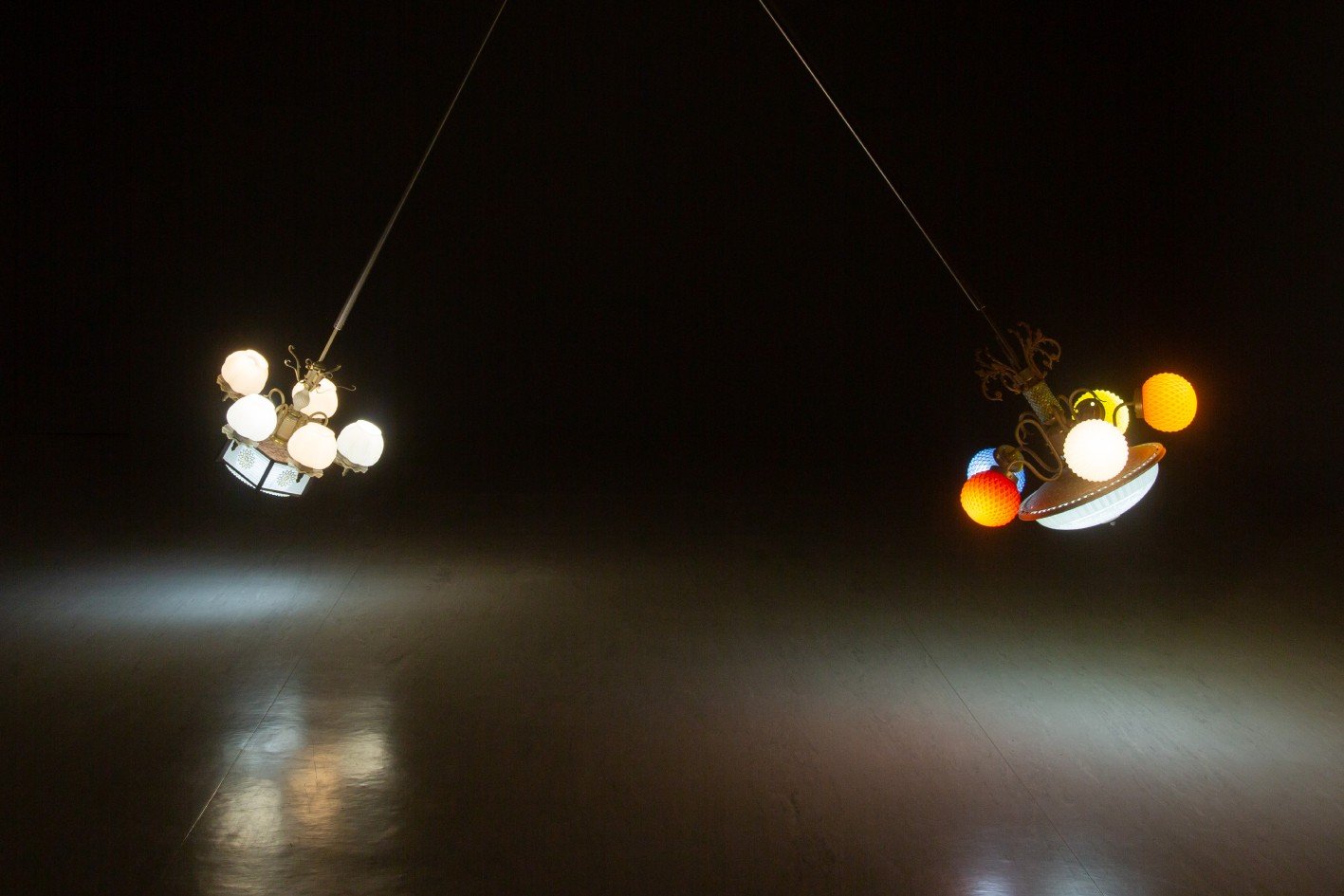

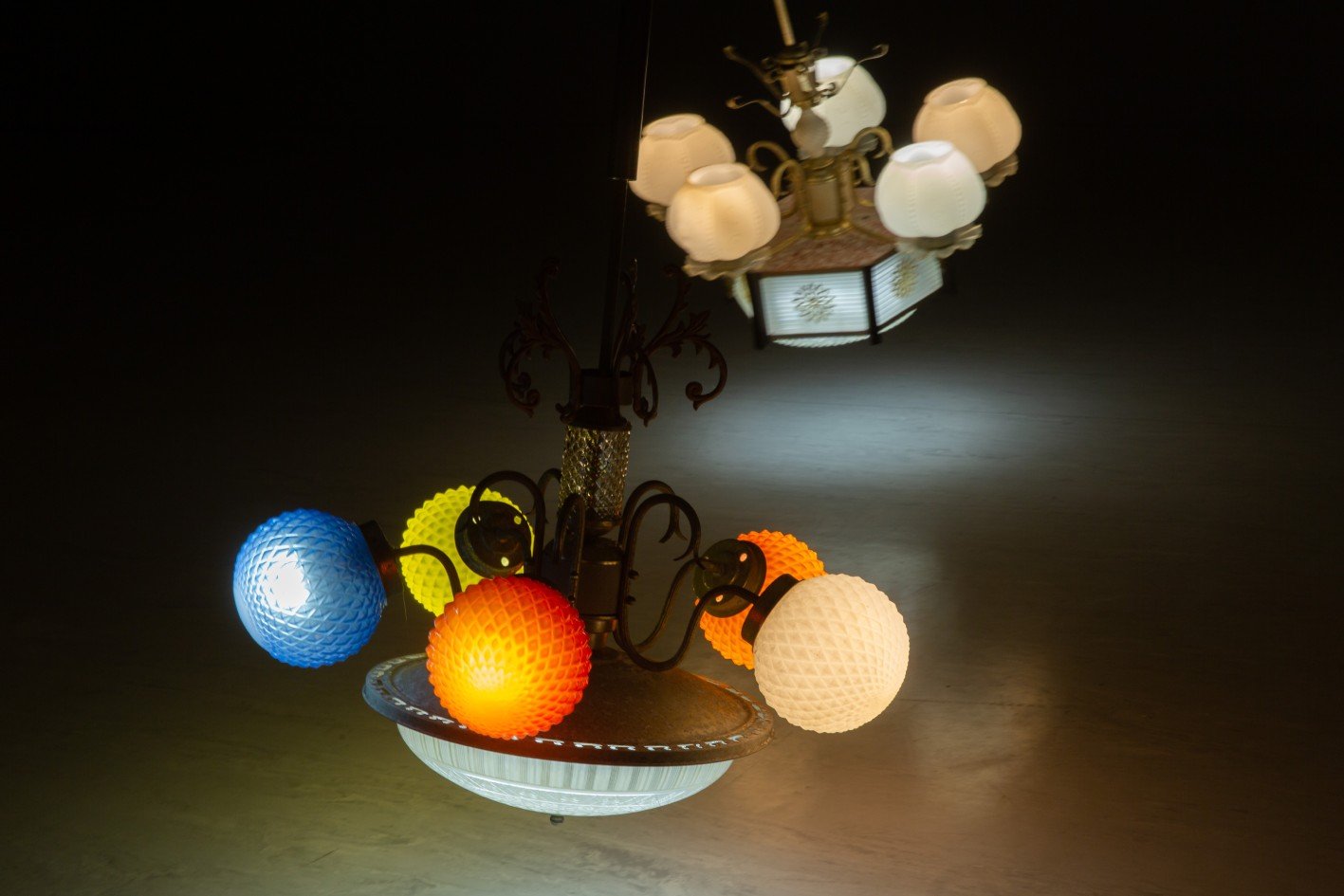
開光的吊燈 / 約 200x310x480H 公分 / 2件古董吊燈、道教開光儀式、動力裝置 / 2024
Consecrated Chandelier / approx. 200x310x480H cm / 2 vintage chandeliers, Taoist consecration ritual, kinetic installation / 2024
幾年前,我買下了基隆一棟荒廢多年的老房子。整理屋內空間時,我發現兩盞自 1970 年代便一直懸掛至今的吊燈。房屋早已多年無人居住,台電也已正式停止供電。然而,當我按下牆上的老舊開關後,兩盞吊燈卻亮了起來,而且持續發光。
我沒有試圖解釋這個現象。真正重要的是,它改變了我與這兩盞吊燈之間的關係。一件原本已失去功能、幾乎退出時間流動的物件,再次進入了我的感知,也重新開始與空間、身體與記憶產生聯繫。
我將吊燈帶離那棟房子,接受道教的開光儀式,並重新構造成一件動力裝置。透過延長懸吊結構,吊燈在展覽空間中緩慢而持續地來回擺動。它們不再只是照明器具,也不只是老房子的遺留物,而是在持續的運動中,形成一種新的存在狀態。
在台灣民間信仰中,開光通常被理解為賦予物件靈性的儀式。然而,在這件作品中,我更傾向將它理解為一種重新啟動流動的行動。開光並不是為物件增加某種神祕力量,而是使原本沉寂的物件重新進入場所、時間、記憶、身體與觀看之間的持續流動。
因此,作品所關注的並不是超自然是否存在,而是流動如何生成存在。當一件物件再次開始流動,它所承載的歷史、情感與信仰,也重新開始在人與世界之間循環。
Several years ago, I acquired an abandoned house in Keelung, Taiwan, which had remained uninhabited for decades. While clearing the interior, I discovered two chandeliers that had hung there since the 1970s. The electrical service had long been disconnected by the power company. Yet when I switched on an old wall switch, both chandeliers illuminated and remained lit.
I have never attempted to explain what happened. What mattered was not the phenomenon itself, but the way it transformed my relationship with these forgotten objects. Once stripped of their function and seemingly withdrawn from the flow of time, the chandeliers unexpectedly re-entered my perception, establishing a new relationship with place, memory, and the body.
Rather than preserving them as relics of the abandoned house, I removed the chandeliers from their original setting and brought them through a Taoist consecration ritual before reconstructing them as a kinetic installation. Their suspension system was extended, allowing them to sway slowly and continuously through space. No longer functioning as sources of illumination, they entered another mode of existence through perpetual movement.
In Taiwanese folk belief, consecration is commonly understood as a ritual that endows an object with spiritual presence. In this work, however, I understand consecration differently. It is not the activation of supernatural power, but the reactivation of circulation. Through ritual and movement, an object that had fallen into stillness begins once again to circulate—between place and memory, body and perception, the visible and the invisible.
The work is therefore less concerned with the existence of the supernatural than with the conditions through which circulation comes into being. As the chandeliers continue their slow, pendulum-like movement, they carry with them not only the memory of a house, but also an ongoing relationship between object, ritual, and human experience.
機械工程: 鍾湫浤
鐵架工程:周時雍
3D列印: 彭薔安
攝影: 陳泳任 / 陳宏圖 / 曹旖彣
Mechanical Engineering: Chung Chiu-Hung
Metal Structure: Sean Chou
3D Prints: Chiang-An Peng
Exhibition Photography: Chen Yun-jen / Chen Hong-To / Tsao Yi-Wen