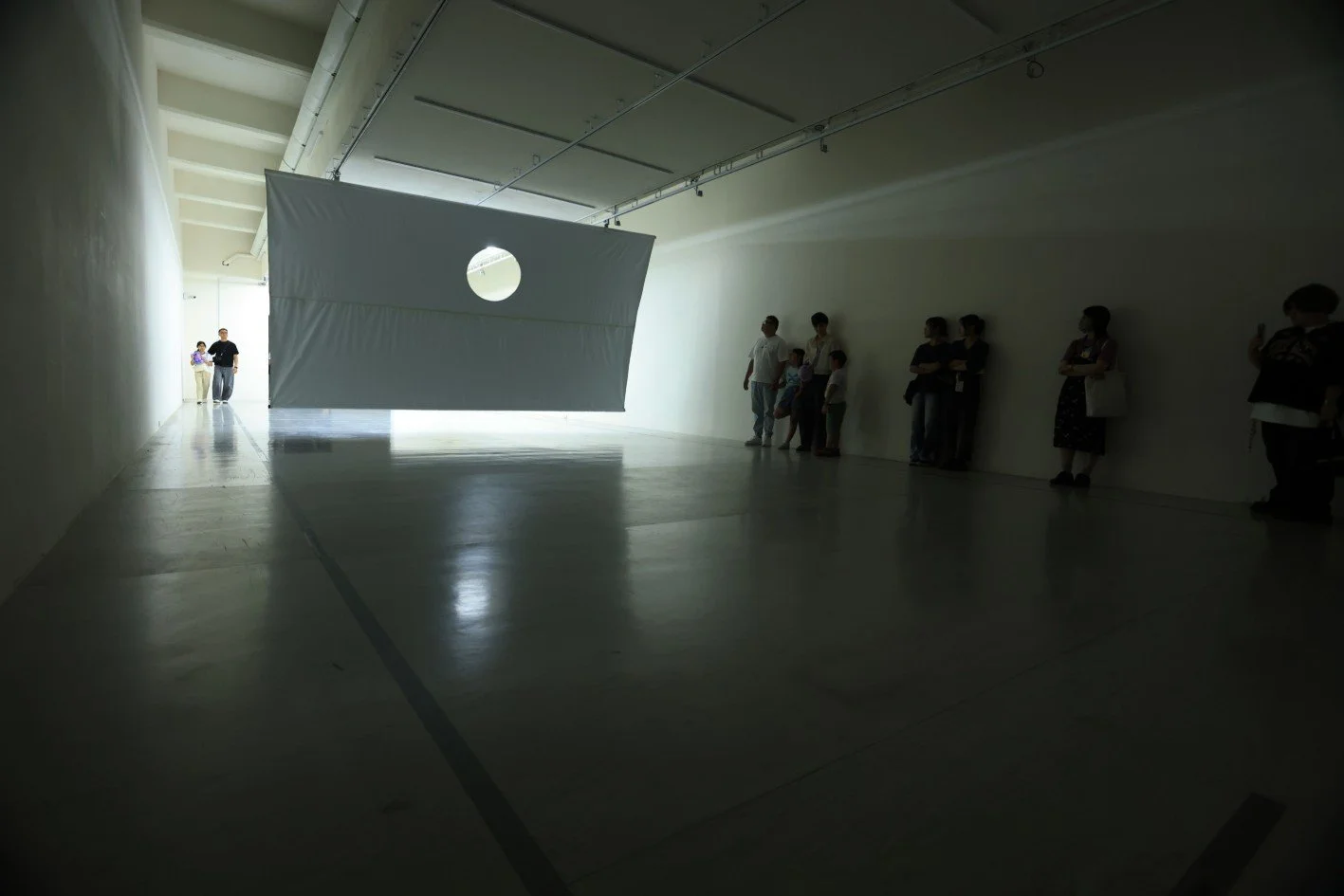
會飛的牆 / 機械裝置 / 現地製作 / 2025
The Flying Wall / Mechanical Installation / Variable dimensions / 2025
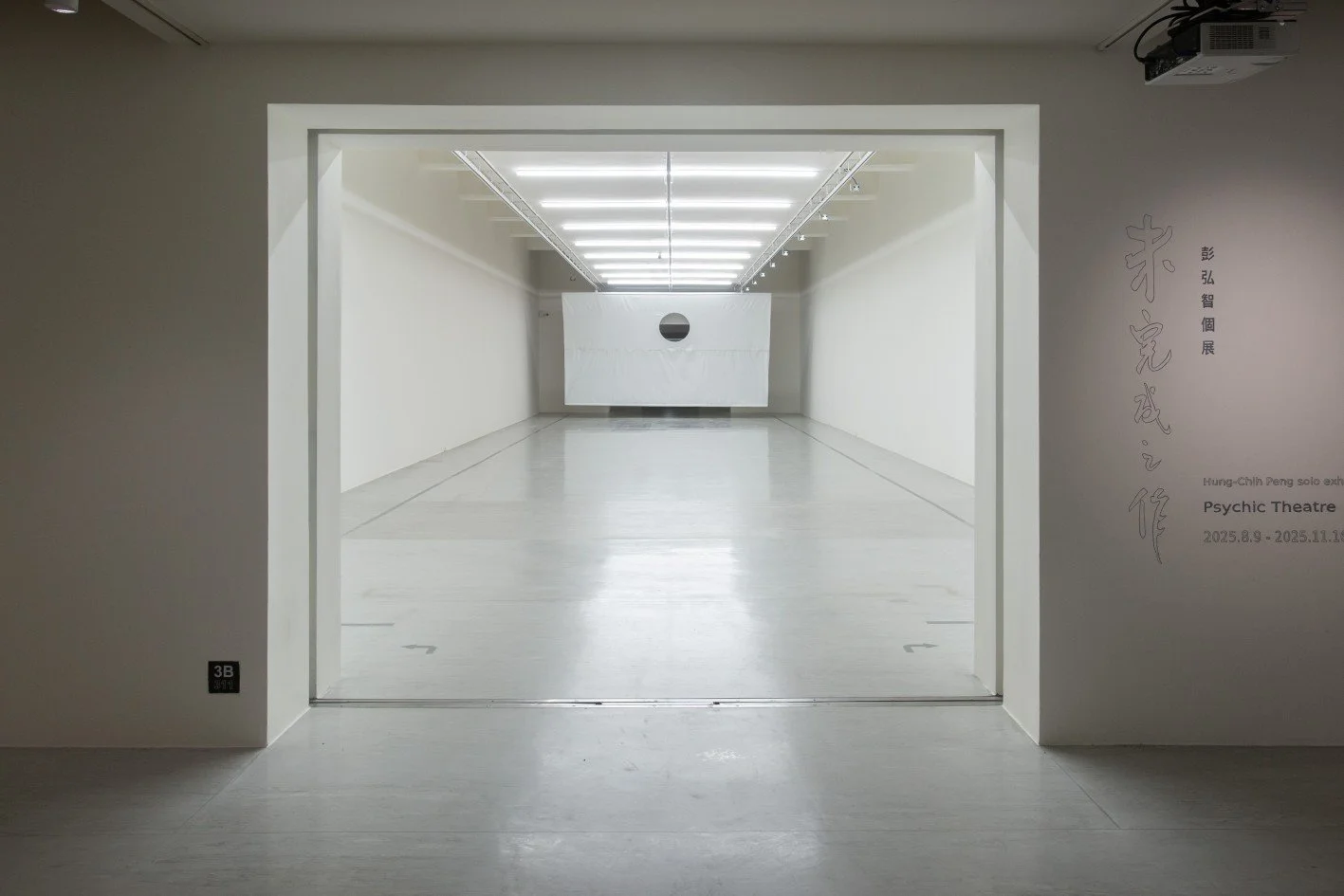
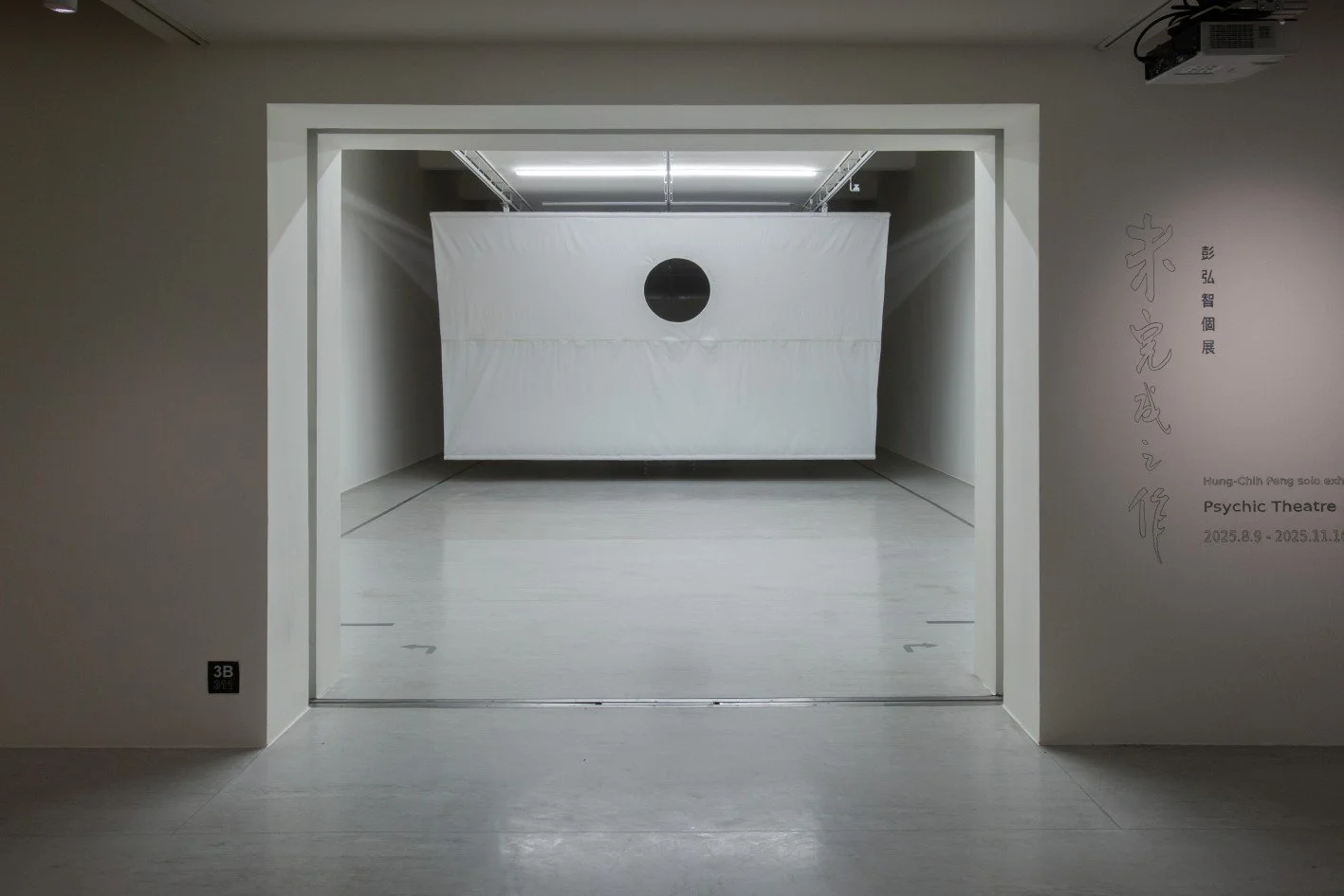
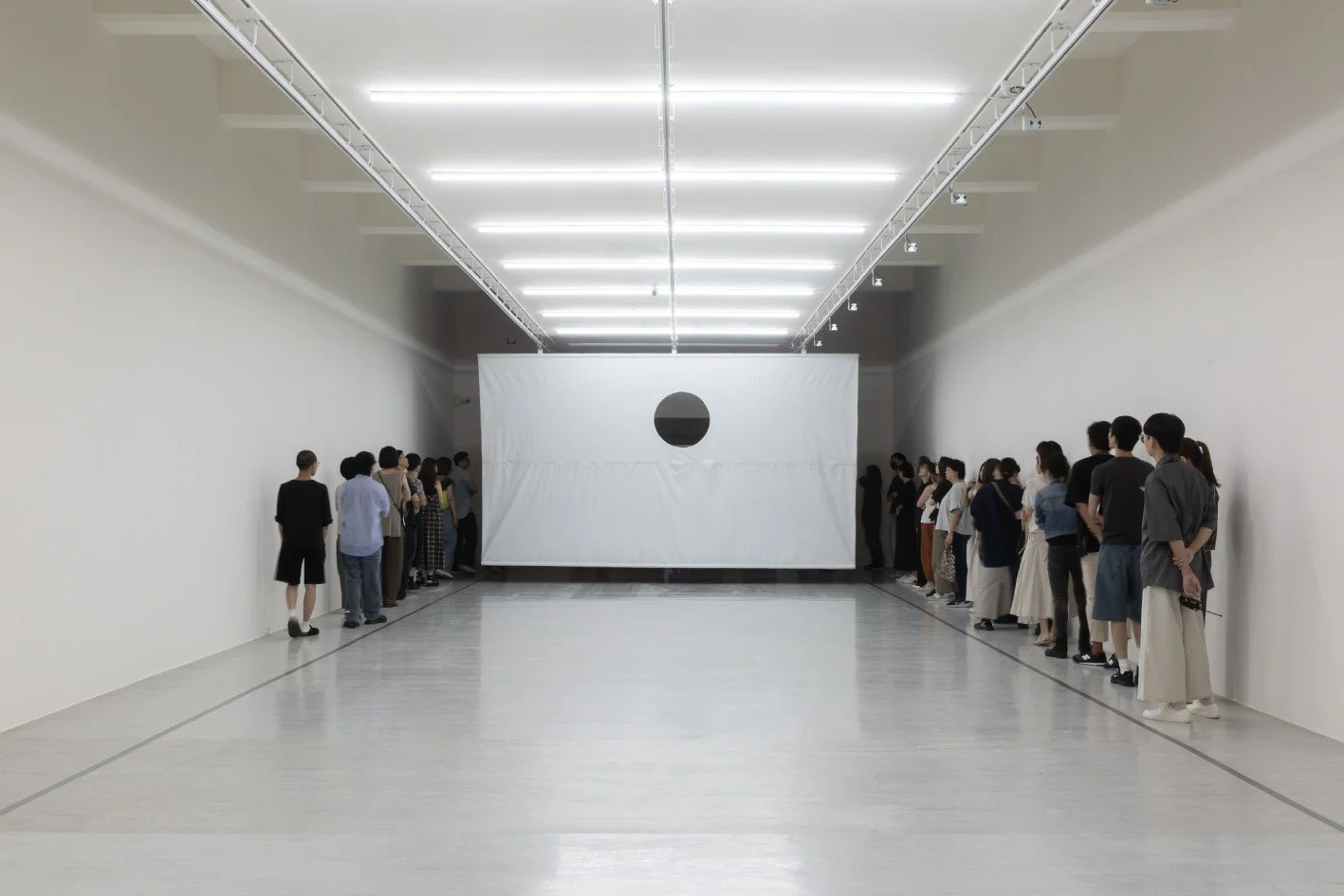
入口處的第一個展區是一個狹長的通道,構成整體十字形展覽空間結構的底部。通道中設置一座大型機械裝置:一面白、一面黑的牆體沿著長廊軸線緩慢往返移動,側邊僅保留供觀眾通行的狹窄空間。
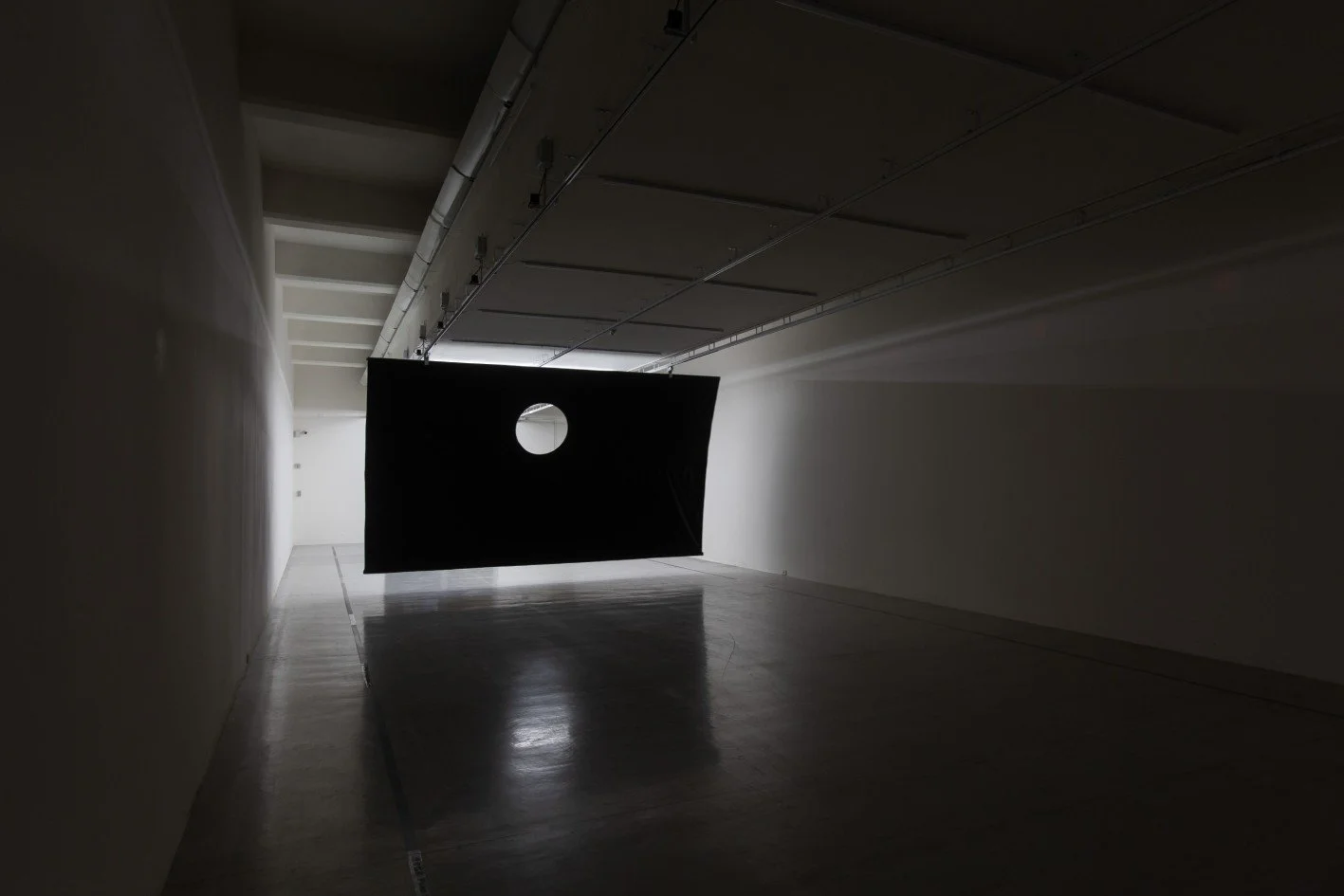
當白色牆面自空間深處向入口方向移動時,沿天花板設置的線性LED燈會逐一熄滅,彷彿牆面在前進的同時吞噬光源,使空間由明亮逐步轉為全黑。當牆體反向移動,黑色的一面退回深處,燈光則重新亮起,空間再次恢復明亮。這種持續往返的循環形成一種節奏性的轉換,如同「光的呼吸」。
帆布牆體中央設有一個圓形開口。從白色一面觀看時,圓孔位於右側;當黑色一面轉向觀眾時,圓孔則出現在左側。這種細微的左右顛倒,使觀者在穿越空間的過程中產生坐標與感知上的錯位。
作品將通道轉化為一個介於光與影、黑與白、陰與陽、生與死之間的過渡空間。這種由亮走向暗、再由暗回到亮的循環,也與影片中靈媒對另一個世界的描述相互呼應,使整個空間成為一條跨越不同狀態與世界的觀看通道。
The first exhibition zone is a narrow, elongated corridor that forms the base of the exhibition’s cruciform spatial structure. Within this passage, a large mechanical wall moves slowly back and forth along the length of the corridor. One side is white, the other black, while a narrow strip along the edge remains open for viewers to pass.
As the white surface advances from the far end of the corridor toward the entrance, linear LED lights mounted along the ceiling gradually switch off one by one. The wall seems to absorb the light as it approaches, transforming the space from bright white into complete darkness. As the wall reverses direction, the black side recedes and the lights return, restoring the corridor to brightness. This continuous oscillation creates a rhythmic transition between illumination and darkness—a kind of breathing of light.
A circular opening is cut into the center of the canvas wall. From the white side, it appears on the right; from the black side, it appears on the left. This subtle reversal produces a spatial and perceptual disorientation as viewers move through the corridor.
The installation functions as a threshold: a passage between light and shadow, white and black, yin and yang, life and death. Its repeated movement from brightness into darkness and back again echoes descriptions given by mediums in the accompanying film, where the passage between worlds is imagined as a transition from light to darkness and from darkness back into light.
機械工程: 賴躍仁
組裝維護: 林孟洲
展覽攝影: 陳泳任 / 陳宏圖 / 曹旖彣 / 彭弘智
Mechanical Engineering: Lai Yao-Jen
Assembly / Maintenance: Lin Meng -Chou
Exhibition Photography: Chen Yun-jen / Chen Hong-To / Tsao Yi-Wen /
Hung-Chih Peng
