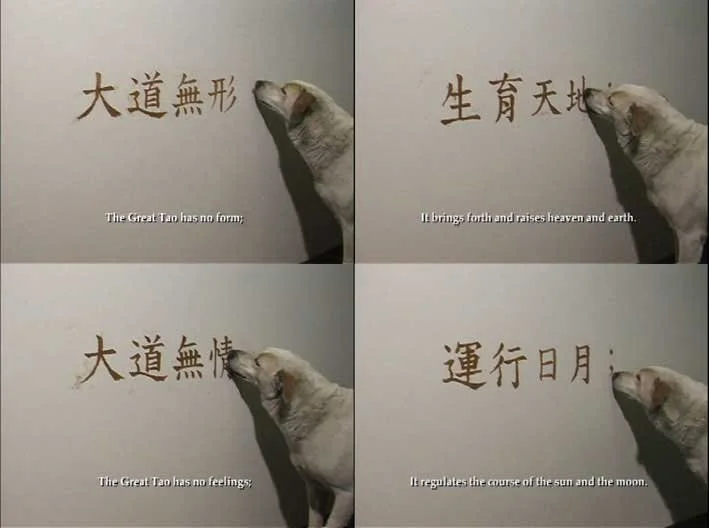
“清靜經“ 2004 單頻道DVD錄影 19分38秒
"Qingjing Jing", 2004, Single Channel DVD, 19m38s
彭弘智的“犬儒清靜經“是關於一隻白色的狗揭露古代道家經典的錄影作品。在這二十分鐘裡,攝影機是固定不動的,一隻狗走入鏡頭,飢餓地舔著白色牆壁,逐漸地暗紅色經文從牠的舌下跑出來,從左至右完成四個字一個句子,然後從鏡頭的右邊退出,如此重複地進出,一直到整個經典完成才結束。
In Peng Hung-Chih's latest video "Qingjing Jing", a white dog reveals ancient Taoist truths. In the 20-minute video where the camera is stationary, a dog comes into frame and hungrily licks the blank white wall making reddish Chinese characters of a traditional Taoist text suddenly appear on the wall. Starting from the left of the screen, the dog licks/reveals a line of text containing four characters, then backs out and exits to the right. This repetitive entering from the left of the screen, licking/revealing words and exiting to the right continues until the whole text has been displayed.
清靜經是古代道家經典,闡訴二分法的世界秩序,萬物皆有所歸的道德指引:如天清地濁,男動女靜等。這經文還提供了如何享有靈性的生活而不被人的動物性所困。在這裡還必須強調中文原文比英文翻譯有更多更開放的解釋,同時也有更多層的寓意。
The texts are ancient Taoist texts and refer to the dichotomous ordering of the world as everything has its defined set place: Heaven is pure, the Earth turbid, Masculine is active, Feminine at rest, etc. The texts also provide moral guidance on how to live a spiritual life uncontrolled by one's carnal desires. It should also be mentioned that the Chinese texts are much more open to interpretation and multi-layered than its English translation.
道家的傳統指導著它的追隨者去接受並發掘自身的原始本性,而這對狗來說是毫不費力的,我們喜歡及欣賞狗兒是因為牠們的自然狗性,而對牠們來說就只是這麼簡單的一件事﹣繼續單純地當它的狗兒就好。既然如此,還有比狗更好的例子了嗎?還有誰能在身心上都能符合真正的道家精神,以闡述自然本性的教義呢?
Taoism tells its followers to accept the universal truths about life, to go with the flow and to get to one's essential and original nature, something that dogs naturally and effortlessly do already. We really like and appreciate dogs for their dog-natures, for them just being themselves: dogs. So what better model is there than a dog, who is basically Taoist in temperament, to reveal the Doctrine of the Principle of Nature?
是的,在影像中,事物雖然被顯示出來但並不代表是真實的,尤其是觀眾並沒有看到拍攝的過程。為了製作這個錄影作品,彭弘智用狗食做的中文字黏在牆上,讓狗欣然地把字舔完,然後他把影像快轉並倒著放映,讓人看起來覺得這個動物正在用牠神奇的唾液及如畫筆般的舌頭來呈現經文。
Yet, things aren't as truthful as they appear to be, as viewers do not see what was actually filmed. To make the video, Peng applied an earth-colored paste of dog food in the shape of the Chinese characters onto the white wall, which the dog then obligingly licks off. The image is then speeded up and played backwards making it appear that the animal is licking the empty wall, and thus exposing the text by his magic saliva and paintbrush tongue.
所以初看這作品會以為是要揭露遠古時代的心靈祕密,但同時它又只是一種動物性的進食行為,好像自覺性的吃掉自己的話語。攝影機靜止不動的取景暗示著一種客觀性,一種單純的記錄現實,不在鏡頭前做任何的更動。甚且,錄影帶是具有強烈的說服力的,當我們在電視新聞上看著充滿著錄影帶影像所編織而成的現實,及這種影像輔助文字的力量時,它說服著我們這就是我們生活上的真實。不論如何,在彭弘智顛倒的世界裡,文字很有力量。在這裡錄影帶上的顛倒,也將道家秩序上的意義帶來一種同現實一起令人困擾及困惑的巧智,也因此它提供了對世界一種反向的再定義。
So Peng's video at first seems to be about divulging ancient spiritual secrets, but it is also a cannibalistic consumption, the self-conscious eating of one's words. The use of a stationary camera often implies objectivity as it is solely recording the reality unfolding before the lens. And video is strongly persuasive in convincing us of the "truth" of life as seen by TV news programs that abound with video documentation proving the reality of the filmic image and the power of the moving picture over words. However, in Peng's inverted world, words have power. The reversal in the video also puts the Taoist sense of order into upheaval, confusing artifice with reality, and thus providing us with a topsy-turvy redefinition of the world.
內文 The Scripture:
《清淨經》Qingjing Jing - Purity and Tranquility Scripture
大道無形
The Great Tao has no form;
生育天地
It brings forth and raises heaven and earth.
大道無情
The Great Tao has no feelings;
運行日月
It regulates the course of the sun and the moon.
大道無名
The Great Tao has no name;
長養萬物
It raises and nourishes the myriad beings.
吾不知其名
I do not know its name-
強名曰道
So I call it Tao.
夫道者。有清有濁,有動有靜。
The Tao can be pure or turbid, moving or tranquil.
天清地濁
Heaven is pure, earth is turbid;
天動地靜
Heaven is moving, earth is tranquil.
男清女濁
The male is pure, the female is turbid;
男動女靜
The male is moving, the female is tranquil.
降本流末
Descending from the origin, Flowing toward the end,
而生萬物
The myriad beings are being born.
清者濁之源
Purity - the source of turbidity.
動者靜之基
Movement - the root of tranquility.
人能常清靜
Always be pure and tranquil;
天地悉皆歸
Heaven and earth return to the primordial.
夫人神好清
The human spirit is fond of purity,
而心擾之
But the mind disturbs it.
人心好靜
The human mind is fond of tranquility,
而慾牽之
But desires meddle with it.
常能遣其慾
Get rid of desires for good,
而心自靜
And the mind will be calm.
澄其心
Cleanse your mind,
而神自清
And the spirit will be pure.
自然六慾不生
Naturally the six desires won't arise,
三毒消滅
The three poisons are destroyed.
所以不能者
Whoever cannot do this
為心未澄
Has not yet cleansed his mind,
慾未遣也
His desires are not yet driven out.
能遣之者
Those who have abandoned their desires:
內觀其心
Observe your mind by introspection -
心無其心
And see there is no mind.
外觀其形
Then observe the body, Look at yourself from without -
形無其形
And see there is no body.
遠觀其物
Then observe others by glancing out afar -
物無其物
And see there are no beings.
三者即悟
Once you have realized these three,
唯見於空
You observe emptiness!
觀空亦空
Use emptiness to observe emptiness,
空無所空
And see there is no emptiness.
所空既無
When even emptiness is no more,
無無亦無
There is no more nonbeing either.
無無既無
Without even the existence of nonbeing
湛然常寂
There is only serenity, Profound and everlasting.
寂無所寂
When serenity dissolves in nothingness -
慾豈能生?
How could there be desires?
慾既不生
When no desires arise
即是真靜
You have found true tranquility.
真常應物
In true tranquility, go along with beings;
真常得性
In true permanence, realize inner nature.
常應常靜
Forever going along, forever tranquil -
常清靜矣!
This is permanent purity, lasting tranquility.
如此清靜
In purity and tranquility,
漸入真道
Gradually enter the true Tao.
既入真道
When the true Tao is entered,
名為得道
It is realized.
雖名得道
Though we speak of "realized,"
實無所得
Actually there is nothing to attain.
為化眾生,名為得道
Rather, we speak of realization when someone begins to transform the myriad beings.
能悟之者
Only who has properly understood this
可傳聖道
Is worthy to transmit the sages' Tao.
上士無爭
The highest gentleman does not fight;
下士好爭
The lesser gentleman loves to fight.
上德不德
Highest Virtue is free from Virtue;
下德執德
Lesser Virtue clings to Virtue.
執著之者
All clinging and attachments
不明道德
Have nothing to do with the Tao or the Virtue.
眾生所以不得真道者
People fail to realize the Tao
為有妄心
Because they have deviant minds.
既有妄心
Deviance in the mind
即驚其神
Means the spirit is alarmed.
既驚其神
Spirit alarmed,
即著萬物
There is clinging to things.
既著萬物
Clinging to things,
即生貪求
There is searching and coveting.
既生貪求
Searching and coveting,
即是煩惱
There are passions and afflictions.
煩惱妄想
Passions, afflictions, deviance, and imaginings
憂苦身心
Trouble and pester mind and body.
便遭濁辱
Then one falls into turbidity and shame,
流浪生死
Ups and downs, life and death.
常沉苦海
Forever immersed in the sea of misery,
永失真道
One is in eternity lost to the true Tao.
真常之道
The Tao of true permanence
悟者自得
Will naturally come to those who understand.
得悟道者
Those who understand the realization of the Tao
常清靜矣!
Will rest forever in the pure and tranquil.
Special Thanks to 大塚麻子 Asako Otsuka / 英文簡介 English Introduction by Introduction by 康居易 Susan Kendzulak