

未完成之作:彭弘智個展
Psychic Theater: Hung-Chih Peng Solo Exhibition
2025/08/09 - 2025/11/16
台北市立美術館 Taipei Fine Arts Museum
策展人: 余思穎 Curator: Sharleen Yu
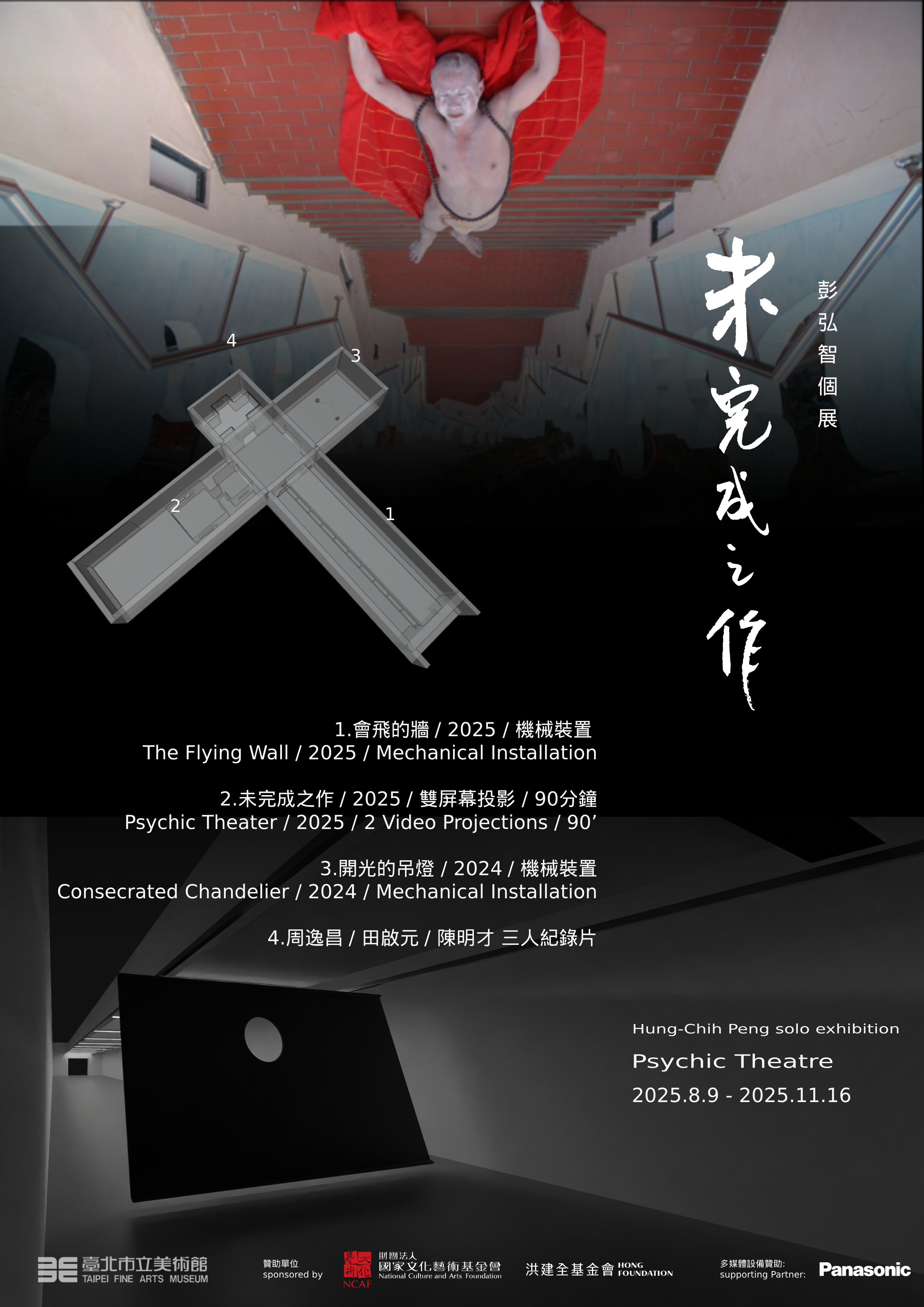
在台灣劇場的發展歷程中,有幾位英年早逝的創作者留下深遠的影響──田啟元(1964–1996)、陳明才(1961–2003)、周逸昌(1948–2016)等人,都是劃時代的先行者。可惜,他們的離世,使許多尚未完成的作品與理念中斷,也讓人不禁思索:他們是否仍有未竟之志?是否留下了尚未說完的故事?這個創作計畫,正是出於我對這個問題的深切渴望──我希望透過靈媒溝通或觀落陰等儀式性的方式,與他們「重逢」,傾聽他們是否有尚待完成的劇本、影像或理念。這將會是一段與亡者共同思索與創作的旅程。並與曾與三位導演共事的表演藝術團體或創作者合作──例如:與周逸昌生前合作密切的印尼 Mugi 舞團、外貌神似陳明才的團長之子,陳明才為同窗的藝術家游源鏗,以及與知名香港居留台灣的舞者楊春江──共同於台南麻豆代天府的「地獄—天堂」空間進行拍攝。呈現我與亡靈共同創作的成果。最終將以雙屏幕電影錄像與大型機械裝置的形式,在一個具有劇場結構、如同十字架般的空間中展出,形成一部橫跨陰陽、融合紀錄與虛構的影像裝置創作。
In the history of Taiwanese theatre, the presence of those who departed too soon continues to reverberate with an almost spectral intensity. Figures such as Tian Chiyuan (1964–1996), Chen Mingcai (1961–2003), and Chou Yichang (1948–2016) were not only pioneering artists of their generation, but also restless visionaries whose premature deaths left behind works unfinished, thoughts interrupted, and questions unresolved. Their absence compels us to wonder: what remains unsaid? Which stories are still waiting to emerge from the silence of their departure? This project originates from a profound desire to confront those unfinished gestures. Through ritualized practices such as spirit mediumship and guān luò yīn, “dialogue with the deceased”, I seek to create new encounters with these artists across the threshold of life and death. The aim is not merely to commemorate but to listen: to ask whether there exist scripts, images, or ideas still yearning for articulation, and to allow the dead to speak once more through the living. The work unfolds as a collaborative constellation, bringing together artists and groups once intertwined with the three directors: the Indonesian Dancer Mugi, long-time collaborators of Chou Yichang; Magnum, Mugi’s son whose appearance uncannily resembles Chen Mingcai; Yu Yuan-Keng, Chen’s contemporary and fellow classmate; and Daniel Yeung, a Hong Kong-born dancer residing in Taiwan. Together, within the infernal-celestial architecture of the Datian Temple in Madou, Tainan, we have staged an encounter where the living and the dead co-create. Ultimately, the project takes shape as a two-channel film installation integrated with large-scale mechanical apparatus, exhibited within a cruciform, theatre-like space. It forms an image-installation that traverses the liminal terrain between the underworld and the everyday, between documentary and fiction—a theatre of haunting, where unfinished works find a second life, and where art itself becomes a medium for speaking across worlds.
如同十字架的展覽空間佈局
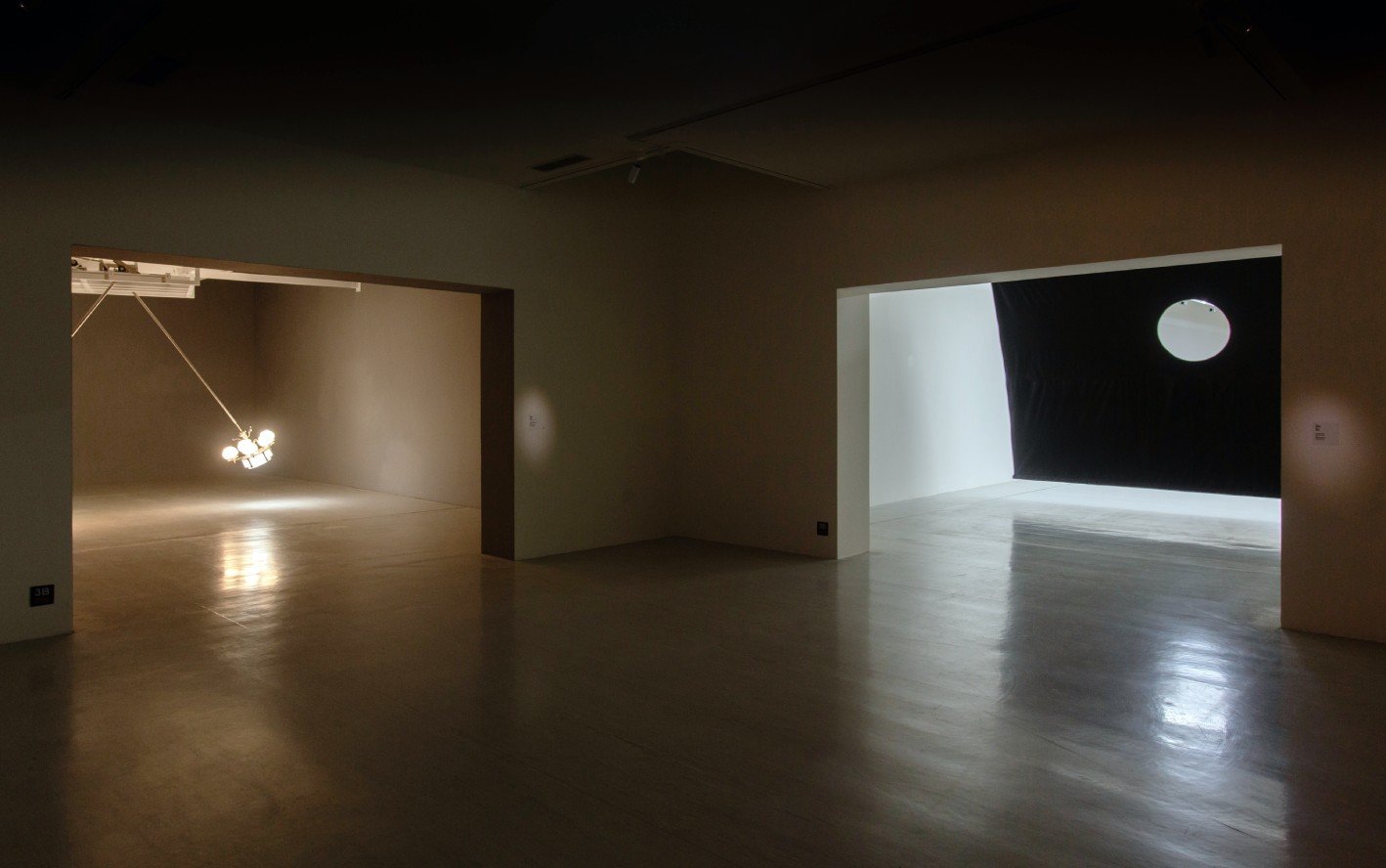
The installation adopts a cruciform spatial structure.
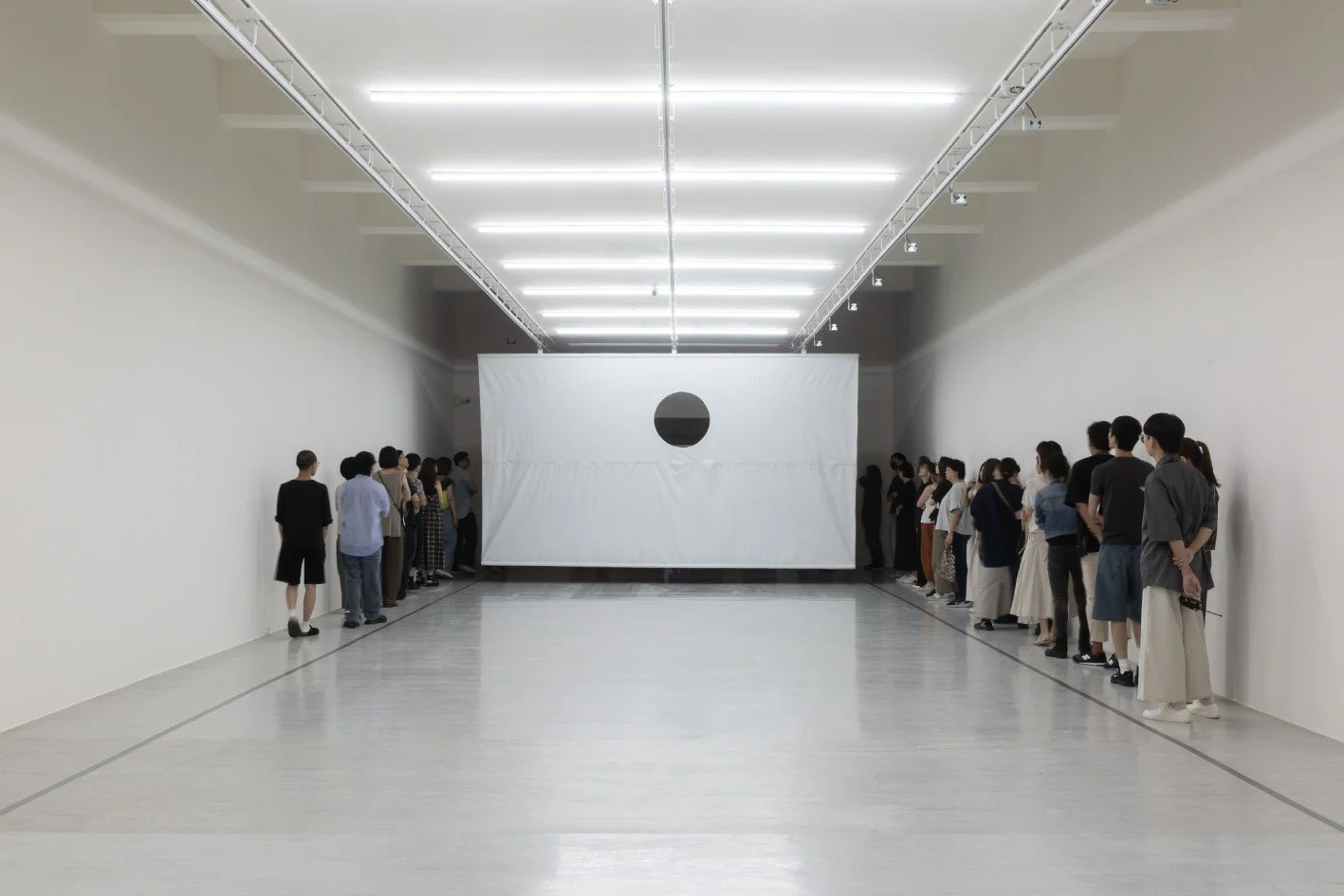
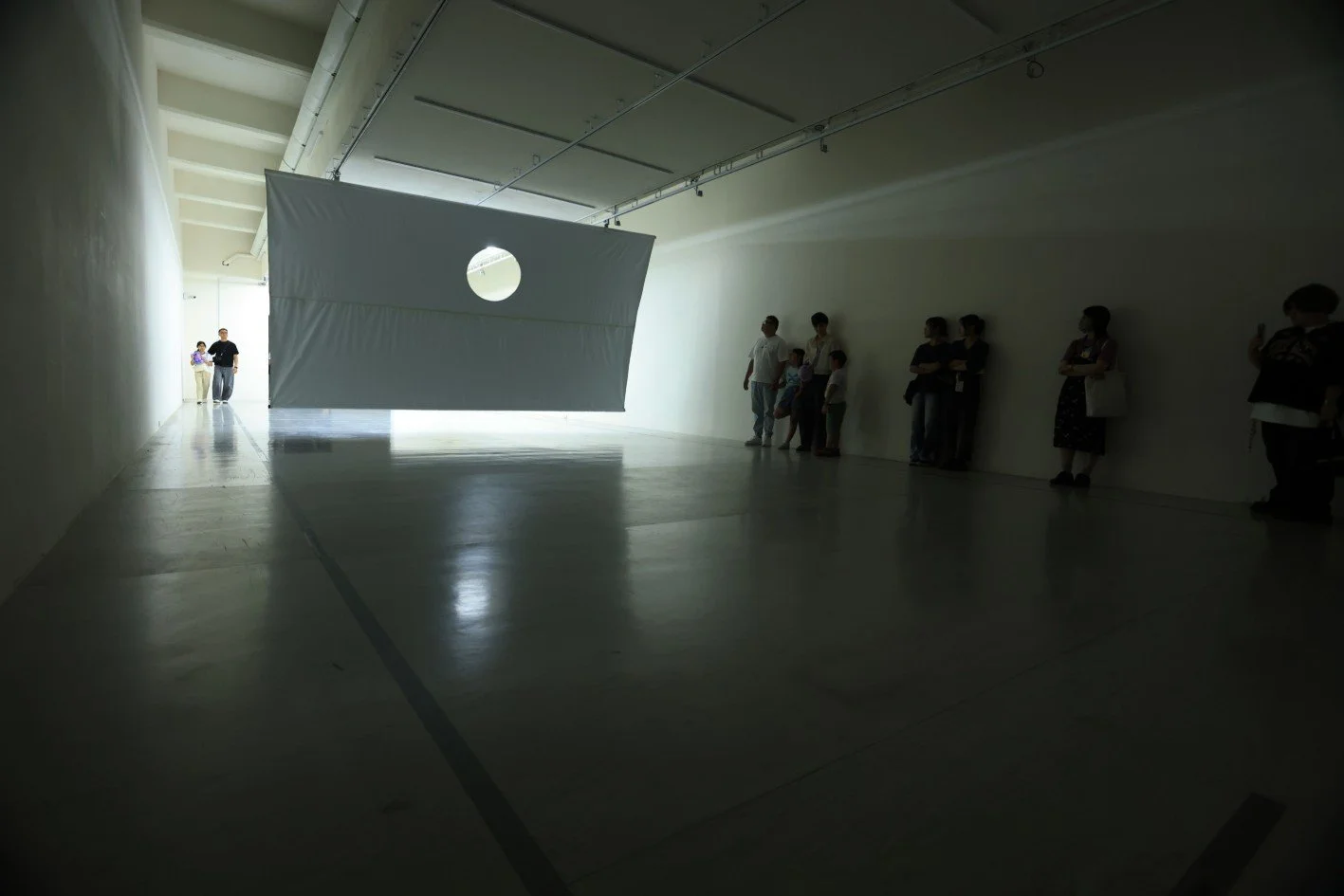
會飛的牆 / 機械裝置 / 現地製作 / 2025
The Flying Wall / Mechanical Installation / Variable dimensions / 2025
入口處的第一個展區,是一個狹長的空間,彷彿是整體空間結構中「十字架」的底部。
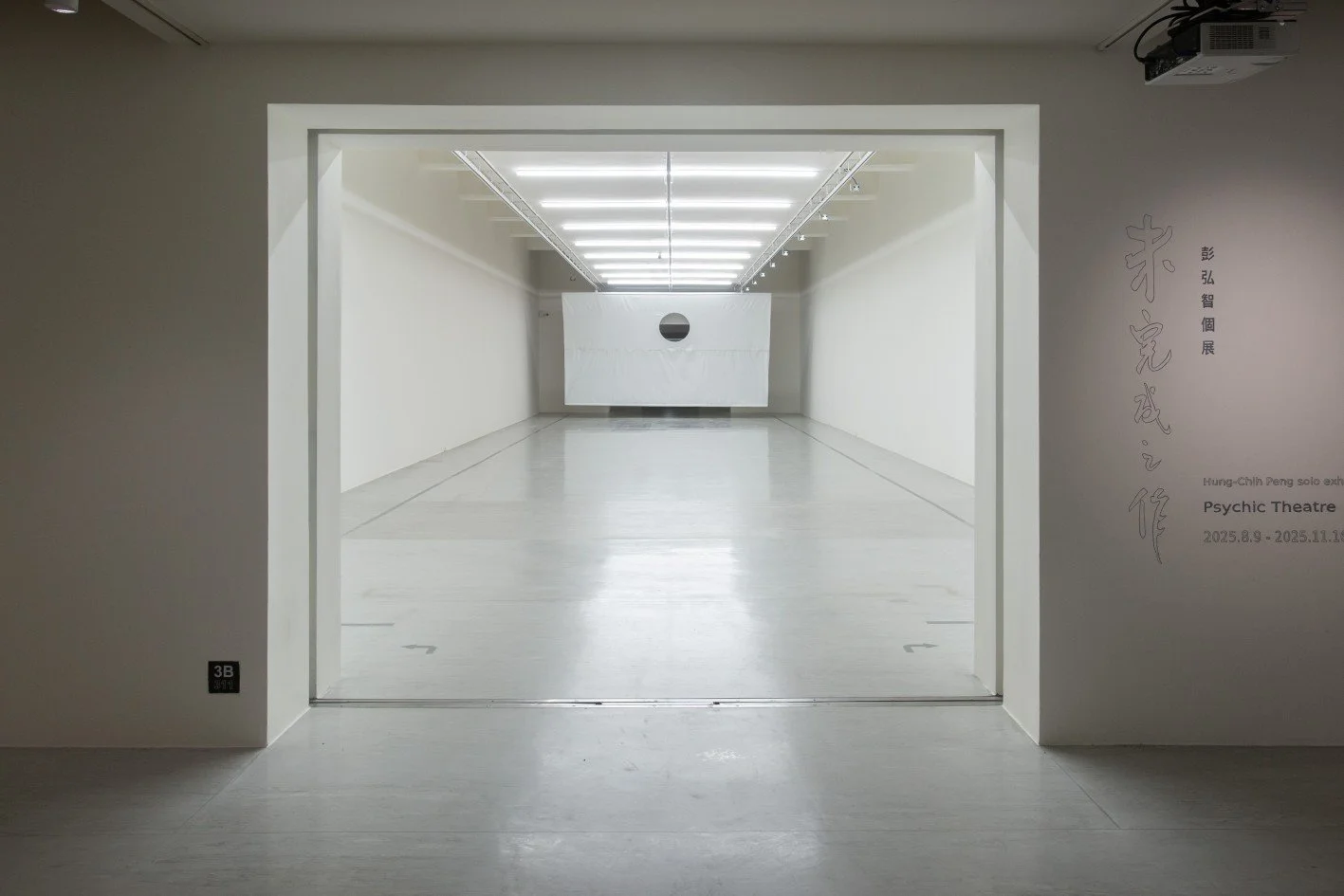
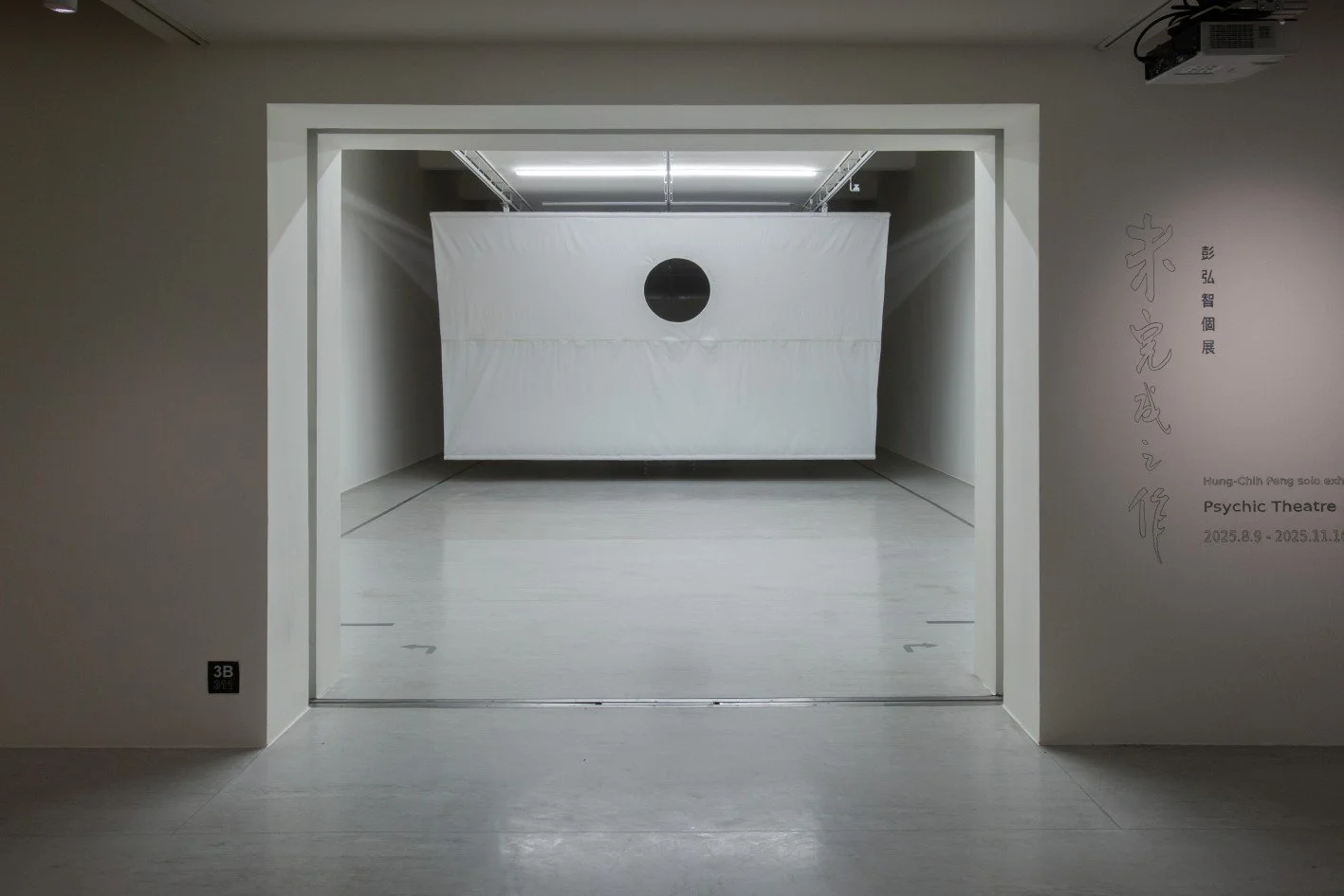
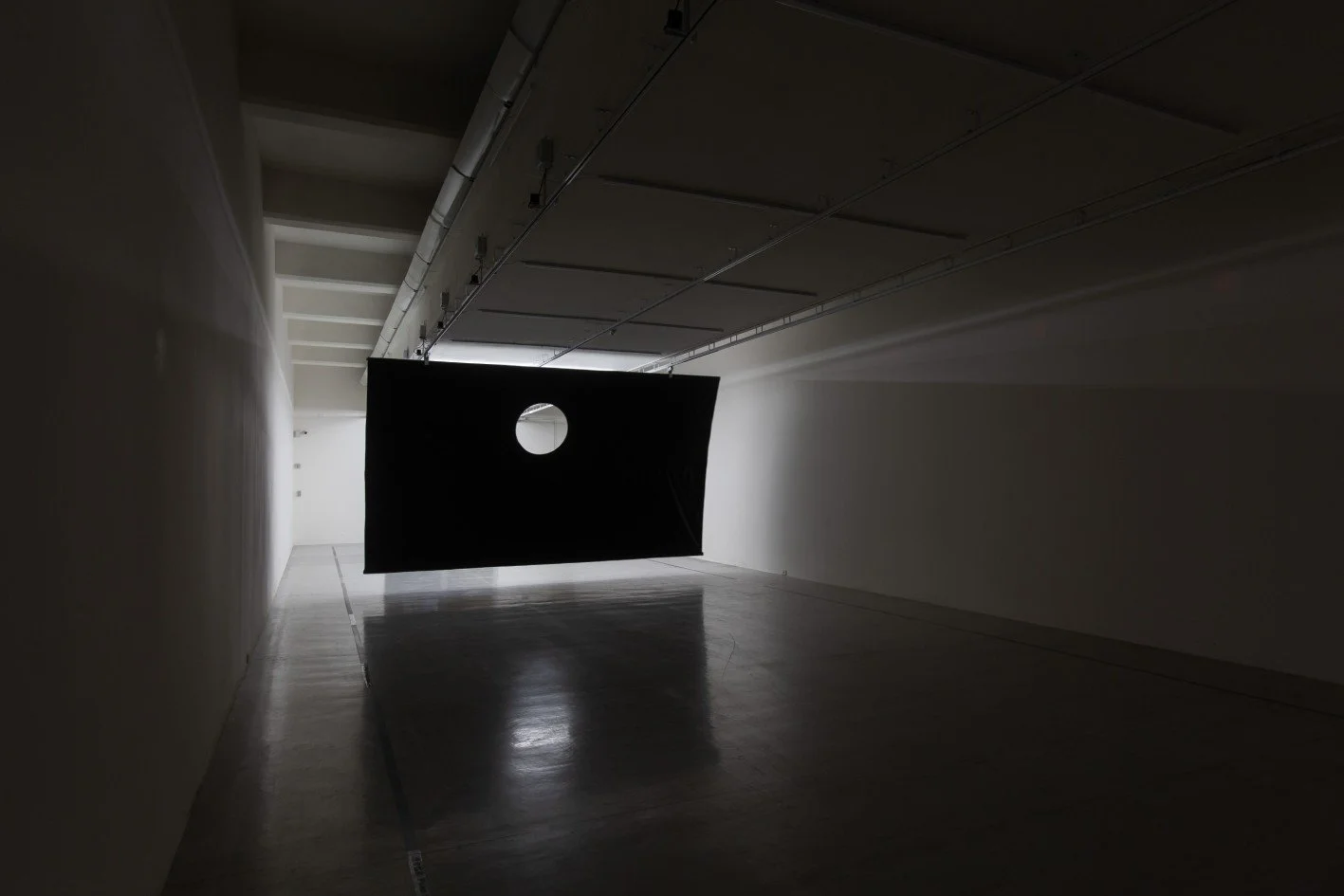
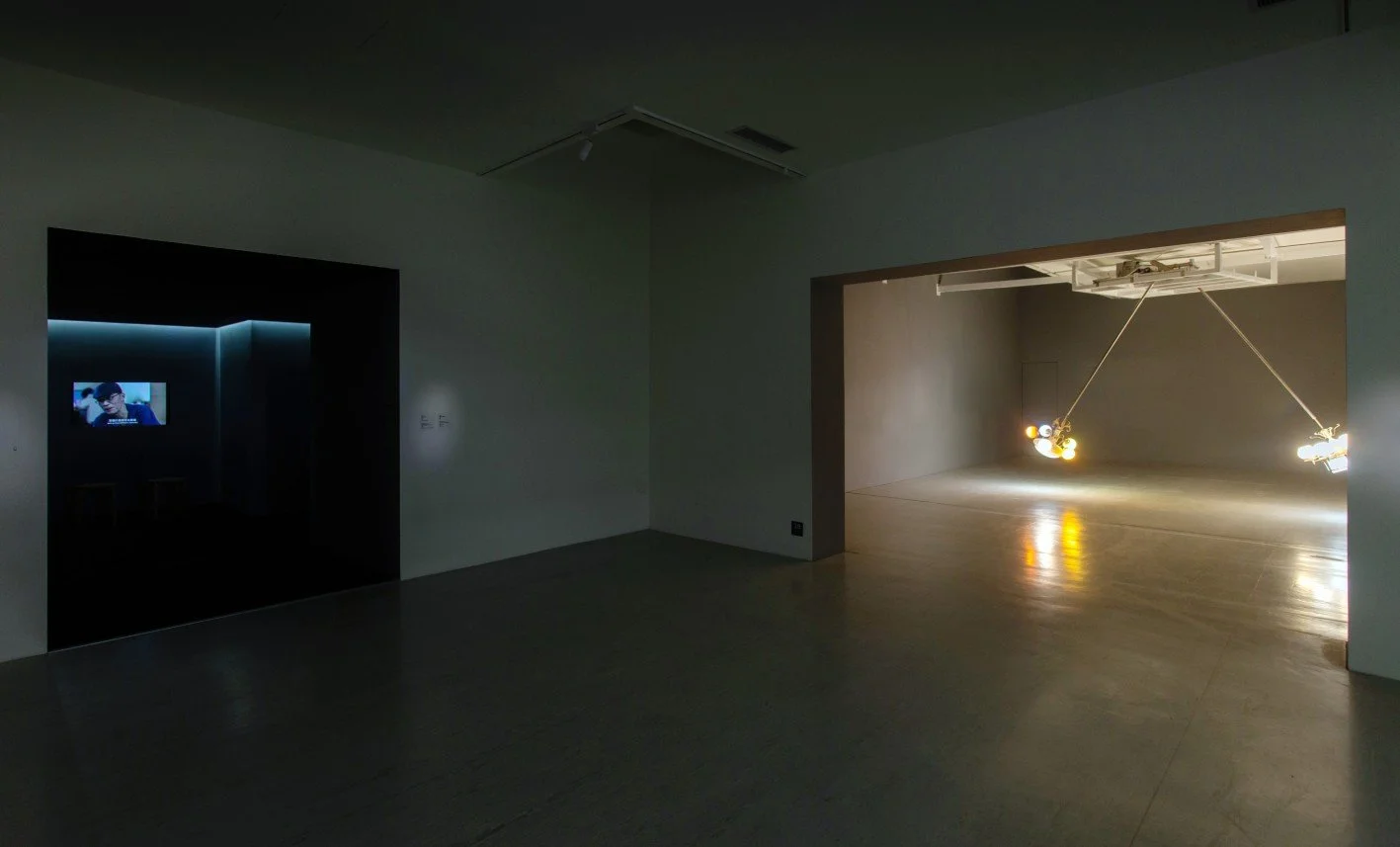
在這個通道式的空間中,設置一座大型的機械裝置──一面能夠移動的牆,一面白、一面黑,沿著長廊的軸線往返移動,旁側僅保留供觀眾安全通行的狹窄通道,讓人與牆幾乎擦身而過。當牆面白色的一面自空間深處緩緩向入口方向飛來,並搭配沿天花板安裝的線性 LED 白光,製造出一種無重力、無影的潔淨狀態。隨著白牆移動接近,燈光逐一熄滅,彷彿牆面吞噬光源,將空間由白推向黑──最終,整個通道化為全黑的場域。接著,黑暗又會重新還原為明亮。如此往返循環,形成一種節奏分明的「光的呼吸」。
帆布的牆體中央開了一個圓洞──從白色這一面看,它是在右邊的;從牆面的另外一邊--黑色那一面來看,圓孔卻位於左側。這個微妙的空間視差,使觀者在前進與後退之間,感受到一種坐標的錯位與感知的顛倒。這是一道觀看電影的通道,一條光與影、黑與白、陰與陽、生與死之間來回穿梭的旅徑。觀者行走其中,宛如進入另一個世界的過渡區。而影片中靈媒所描述的那個「從亮走向暗、再從暗回到亮」的世界,恰與此空間意象巧妙呼應──構成一種跨界的重合,也是一種來自冥界的指引。
The first exhibition zone, located at the entrance, is a narrow and elongated corridor, resembling the “base” of a cruciform spatial structure. Within this transitional passage stands a large-scale mechanical installation titled The Flying Wall: a wall that glides slowly along the central axis of the corridor, moving like a pendulum from white to black and back again. When the white surface emerges from the depths of the corridor, advancing steadily toward the entrance, it is accompanied by a linear glow of LED white light along the ceiling. Yet as the wall draws nearer, the lights are extinguished one by one, until the surface seems to consume the very sources of illumination, pushing the space from white into black. In the end, the corridor is plunged into total darkness. Then, as the wall reverses direction, its black surface recedes, and darkness itself is undone: the lights return, and the space once again becomes immaculate white. This perpetual oscillation creates a distinct rhythm—a breathing of light. At the center of the canvas wall, a circular aperture has been cut. On the white side, the hole appears to the right; when the black side emerges, it shifts to the left. This subtle spatial dislocation produces a perceptual inversion, as if the coordinates of the body were slipping between alignment and estrangement. This is a passageway of cinematic viewing and also a journey traversing back and forth between light and shadow, white and black, yin and yang, life and death. As viewers walk through, they enter a zone of transition, an antechamber to another world. The imagery of this space resonates uncannily with the visions described by the mediums in the film—“Like shifting from brightness into darkness, and then back into light again.” It is here that the metaphors converge: a choreography of thresholds, a crossing of worlds, and a guidance whispered from the underworld itself.
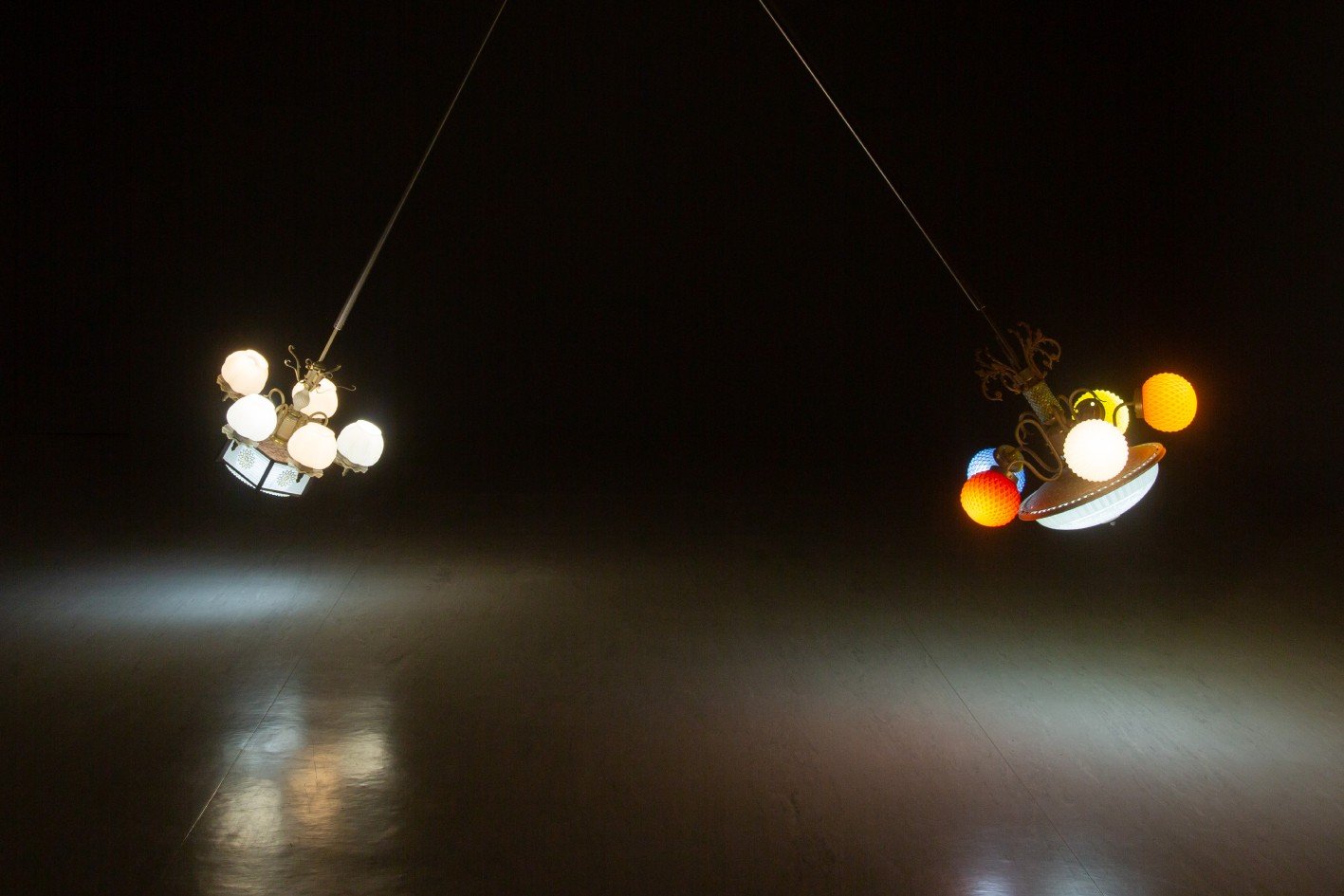
開光的吊燈 / 約 200x310x480H 公分 / 機 械 裝 置 / 2024
Consecrated Chandelier / approx. 200x310x480H cm / Mechanical Installation / 2024
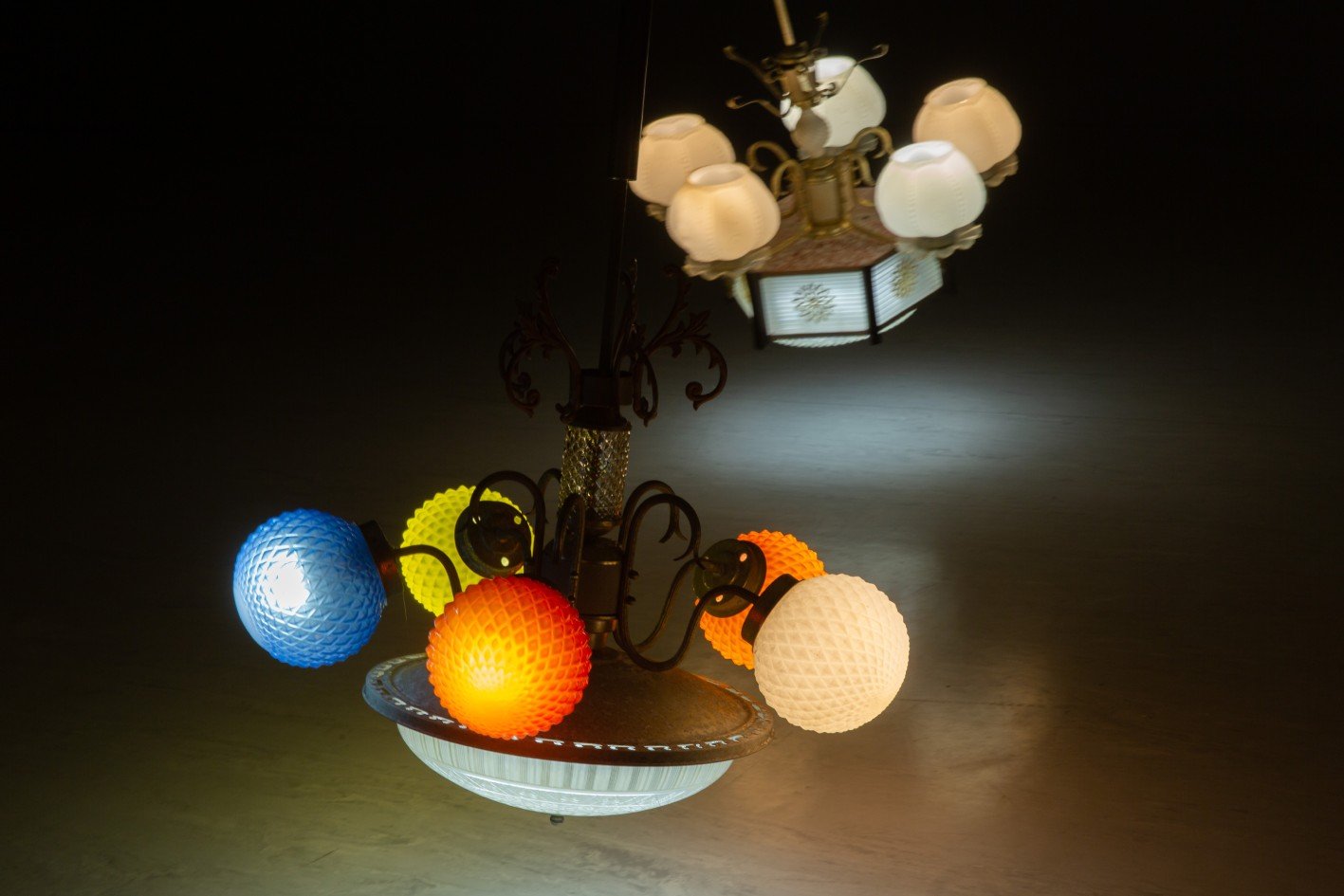
在十字空間的中央偏右位置,設置兩座來自1970年代的吊燈機械裝置“開光的吊燈”。這對吊燈原為我之前裝置作品《正義路安魂曲第二樂章:港都夜雨》所使用,是我因緣際會購入一棟老屋時遺留於其中的兩件物品。這棟屋子早已荒廢多年,電力也早被台電中斷,然而在一次空間整理時,我無意間打開牆上的老式開關,這兩盞吊燈竟神秘地亮了起來——如同靈魂尚未離去,在幽暗中閃爍。這個奇異經驗對我來說是一種召喚,也是一種儀式的啟動。我特別將它們的燈桿拉長,並使其透過機械驅動產生緩慢而規律的擺動。這擺動的節奏,象徵著靈魂的搖曳與徘徊,也讓人聯想到道教儀式中香爐的來回搖晃,或是七爺八爺行儀時雙臂擺動的肢體姿態,一種介於召喚與超渡之間的肢體語言。對我而言,這吊燈的「擺動」更是一種對物件本身的開光過程。在這個空間中,它們不再只是老屋的殘留物件,而成為靈性與記憶的載體。
At the center-right of the cruciform space stand two suspended mechanical chandeliers from the 1970s, titled Consecrated Chandelier. These fixtures were first employed in my earlier installation Justice Road Requiem: Second Movement: Night Rain in the Harbor City. They had originally been left behind in an old house that I was serendipitously able to acquire. The building had long been abandoned, its electricity disconnected for years. Yet during the process of clearing the space, I accidentally flipped an old switch on the wall—and to my astonishment, the two chandeliers flickered to life. Their sudden glow felt uncanny, as though lingering souls had not yet departed, shimmering faintly within the gloom. That moment became, for me, both a summons and a ritual of initiation. I later extended their suspension rods and connected them to a motorized system, so that they swayed with a slow, regular rhythm. This pendular motion signifies the wavering of souls, their hesitation between realms. At the same time, it recalls the gentle rocking of incense burners in Taoist rites, or the swinging arms of the ritual figures Qiye and Baye as they perform their sacred procession. It is a corporeal language suspended between invocation and transcendence. For me, the “swaying” of these chandeliers constitutes an act of consecration, a process of imbuing the objects with spirit. Within this space, they are no longer remnants of a derelict house, but have been transformed into vessels of memory and carriers of the spiritual.
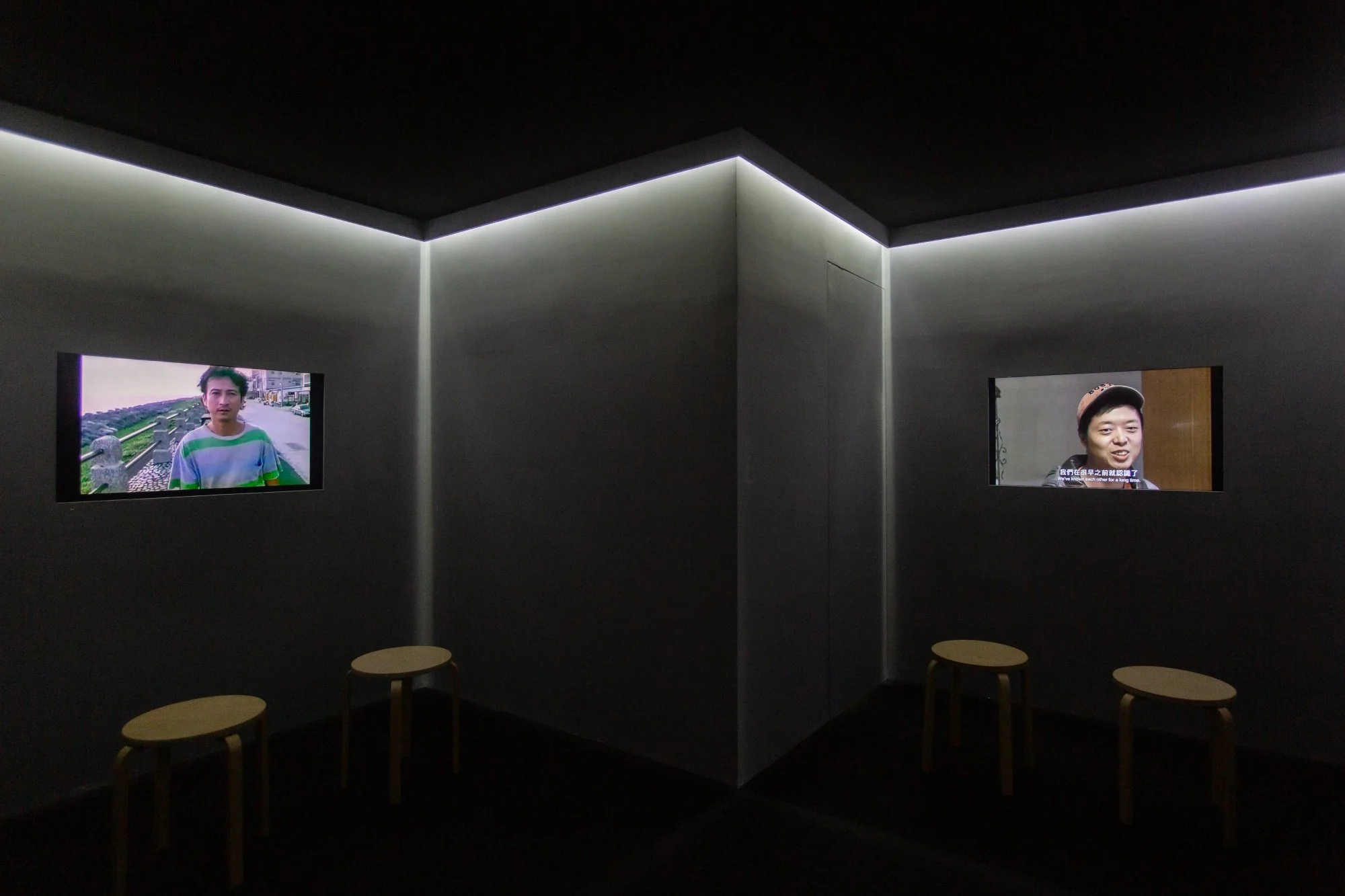
三位劇作家的紀錄片
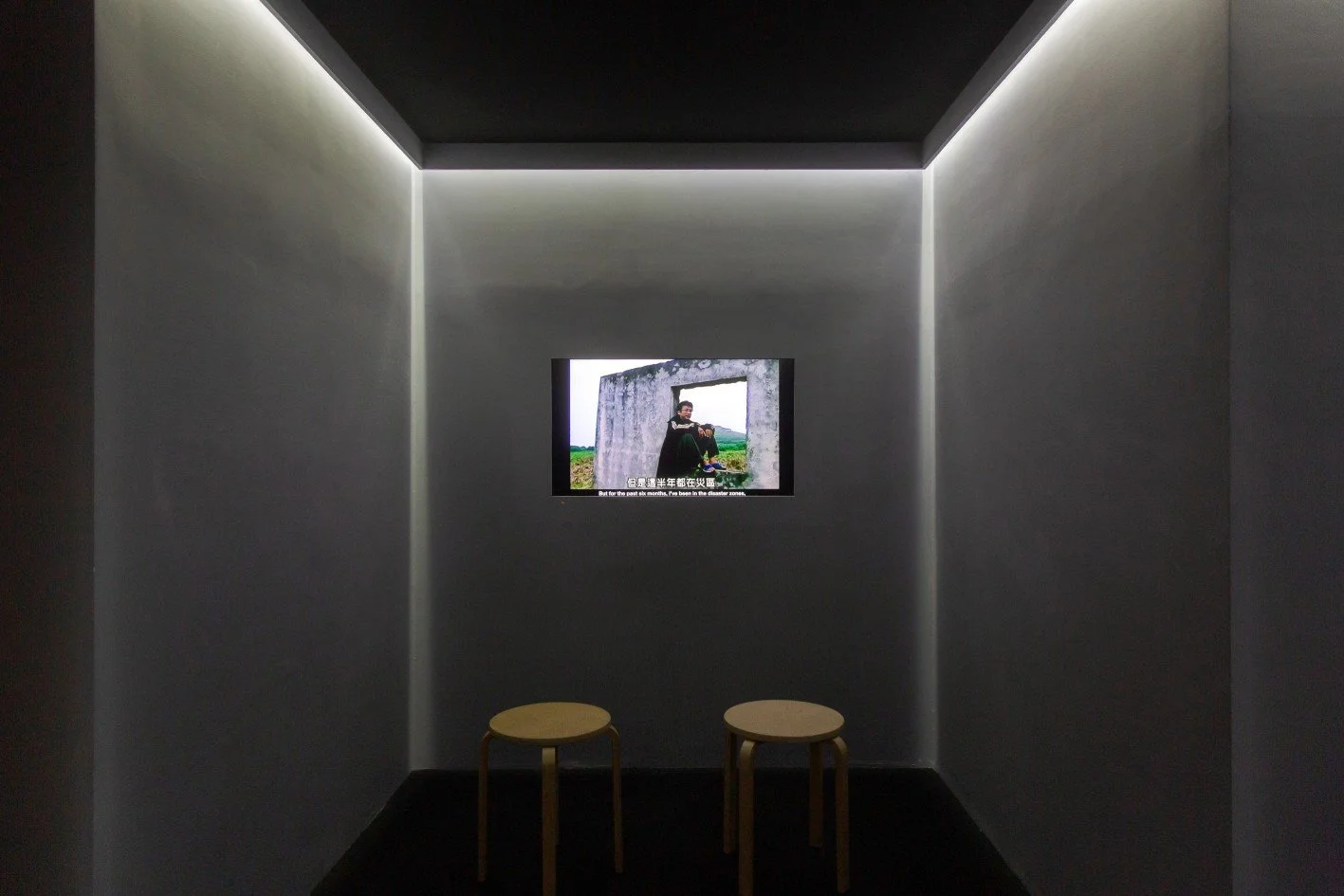
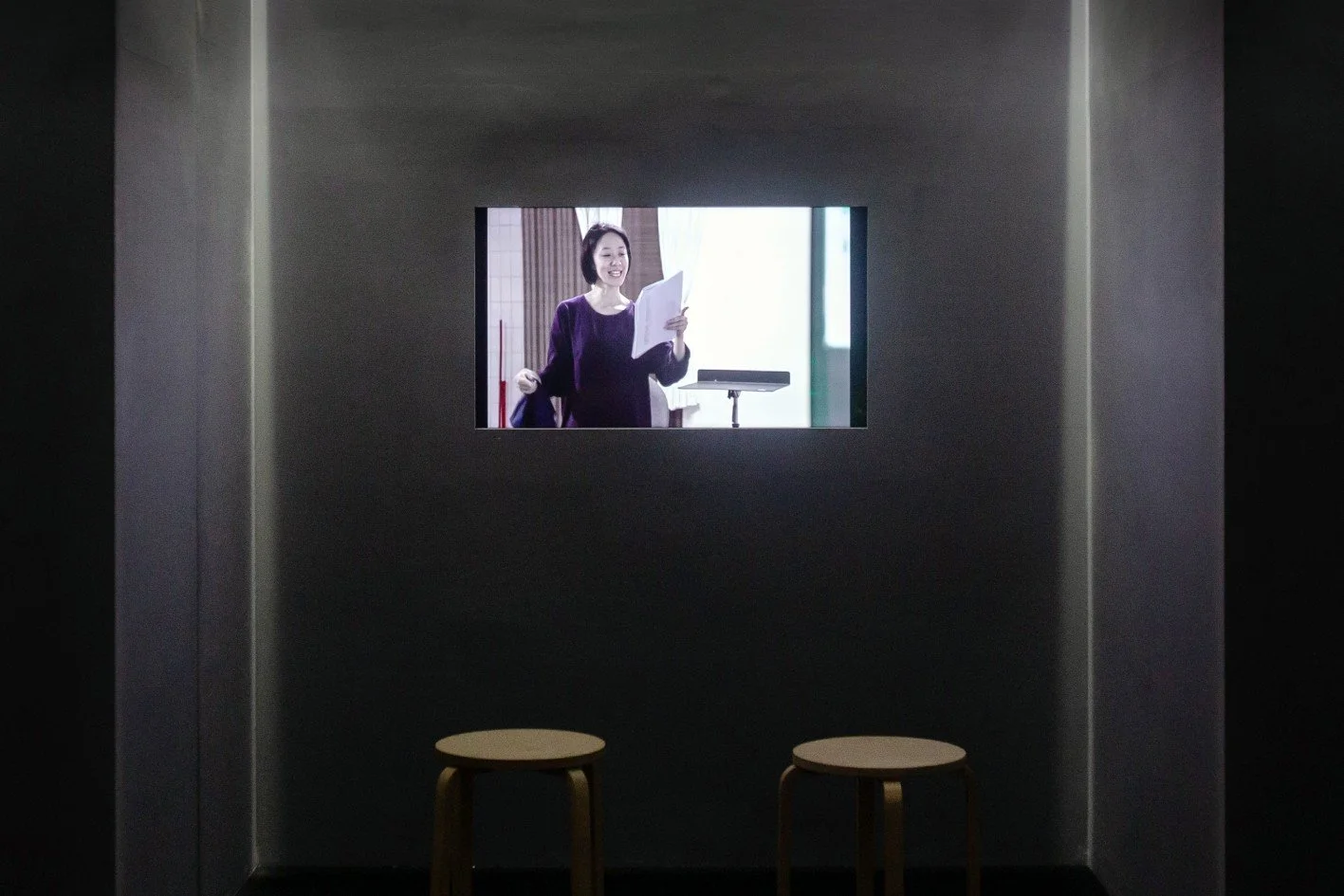
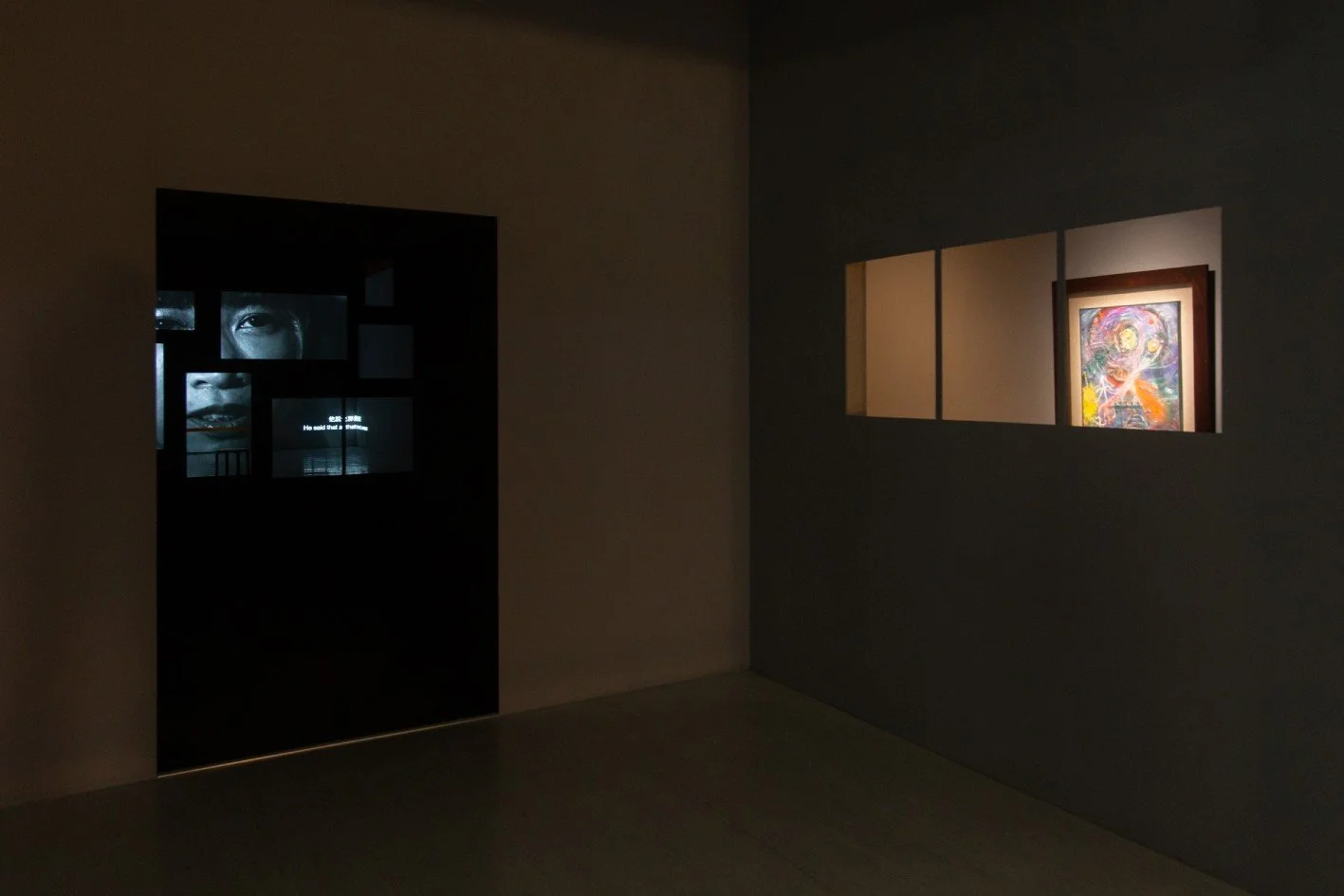
在十字架結構的中心前方,即「十字架頭部」的位置,設置了一個小型放映空間。此空間保留了前一檔展覽留下的木作隔間,恰巧又構成一個十字形的結構,除入口外,其餘三面各自形成獨立放映間,彷彿為三位已故劇場導演量身打造的紀念場所。左側空間播放陳明才的紀錄片《我的綠島》,這是他於過世前三年拍攝的作品。片中可見他深陷憂鬱症的精神狀態,彷彿一個生命走向終點前的掙扎紀錄,然而他身上那股不可掩蓋的明星魅力仍清晰可見。中央正面放映由江子翠基金會製作的紀錄片《周逸昌.造次》,長約三十餘分鐘,完整回顧他一生的創作歷程與行動精神,是目前對周逸昌最具代表性的影像資料。右側則播放尚未完成的田啟元紀錄片,片長十五分鐘,內容聚焦於他生命末期罹患愛滋病後的思想狀態與面對死亡的內在轉變,留下極為真誠且深刻的影像片段。這個房間原為檔案資料展示所規劃,最終卻意外成為三位導演生命故事的交會點。空間本身的十字形結構彷彿冥冥中的安排,讓觀眾得以在短時間內走入他們各自的生命光景,也走入台灣劇場尚未完成的精神史。
Documentary Films of Three Playwrights
At the front of the cruciform structure—specifically at the position corresponding to the “head” of the cross—three small screening spaces are installed. This area retains the wooden partitions left from the previous exhibition, which, by coincidence, also form a cross-shaped configuration. With the exception of the entrance, the remaining three sides are each enclosed as independent screening chambers, as if they were memorial spaces custom-made for the three deceased theatre directors.
The left chamber presents My Green Island, a documentary by Chen Mingcai, filmed three years prior to his suicide. The work reveals his profound struggle with depression, reading as a record of a life approaching its end. Yet, his unmistakable charisma—an irrepressible star quality—remains vividly perceptible throughout.
Directly ahead, the central chamber screens Chou Yichang: Overstepping the Mark, a documentary produced by the Gang-a Tsui Arts and Educational foundation. Running over thirty minutes, the film offers a comprehensive retrospective of his creative trajectory and performative ethos, and currently stands as the most representative visual document of Chou Yichang.
On the right, an unfinished fifteen-minute documentary on Tian Chiyuan is shown. It focuses on his intellectual and emotional state during the final phase of his life after being diagnosed with AIDS, capturing his internal transformation in the face of death. The footage remains strikingly intimate and profoundly sincere.
Originally conceived as a space for archival display, this room ultimately and unexpectedly becomes a point of convergence for the life narratives of the three directors. The cruciform structure of the space itself appears almost predestined, allowing viewers, within a compressed temporal frame, to enter into each of their lived worlds—and, in doing so, to encounter an unfinished spiritual history of Taiwanese theatre.
未完成之作 / 雙屏幕投影 / 93分26秒 / 2025
Psychic Theater / 2 Video Projections / 93m26s / 2025
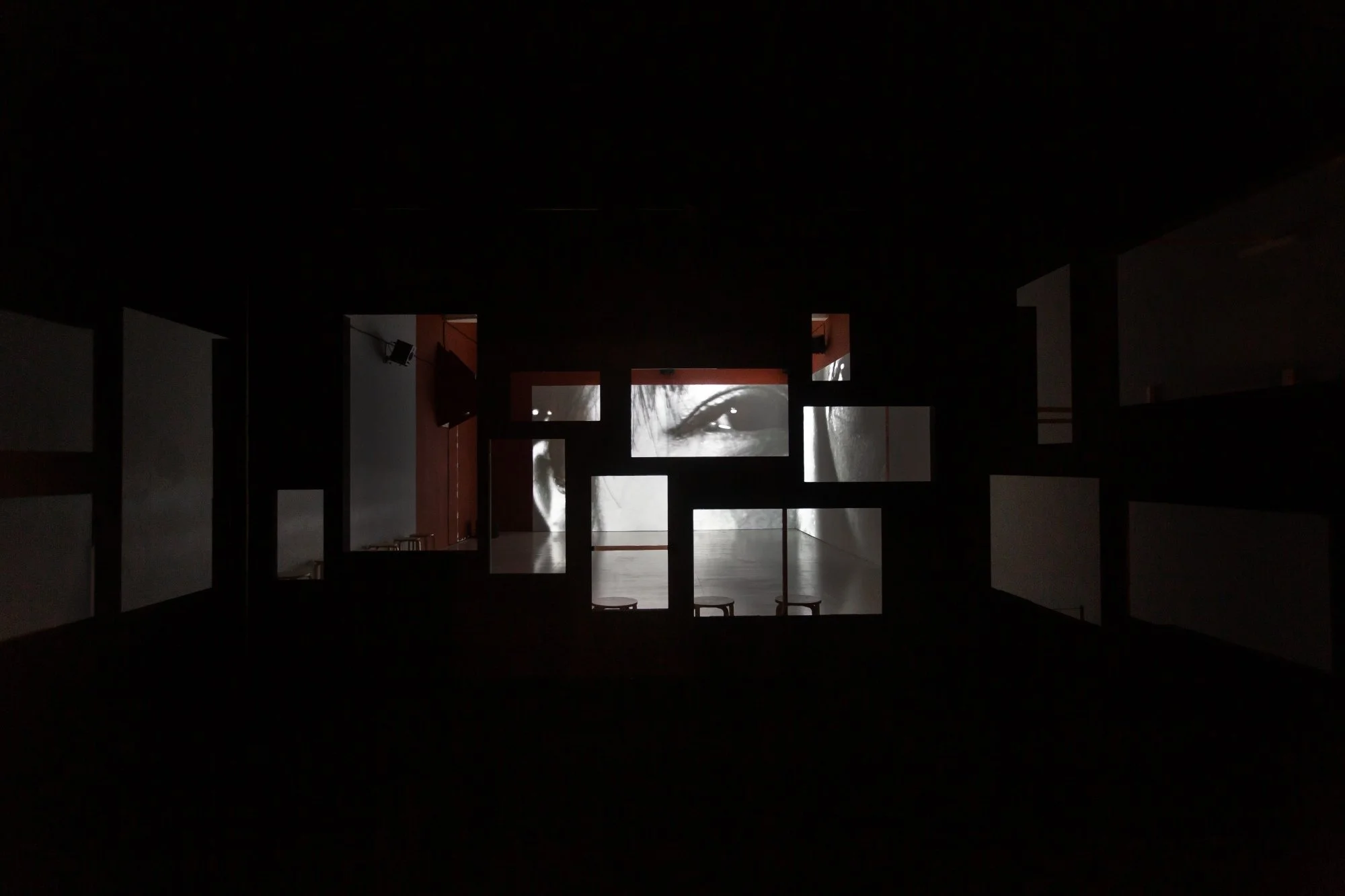
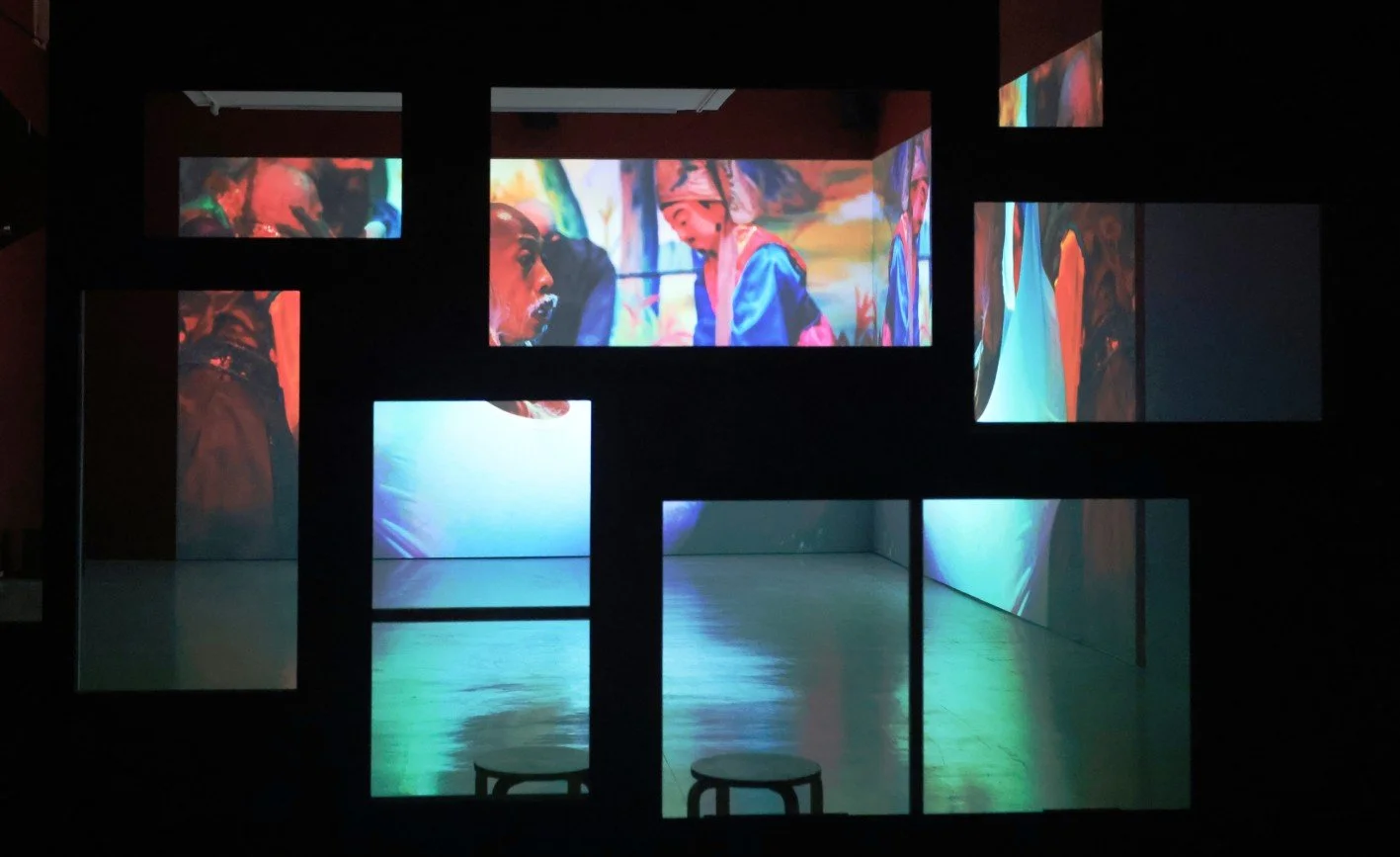
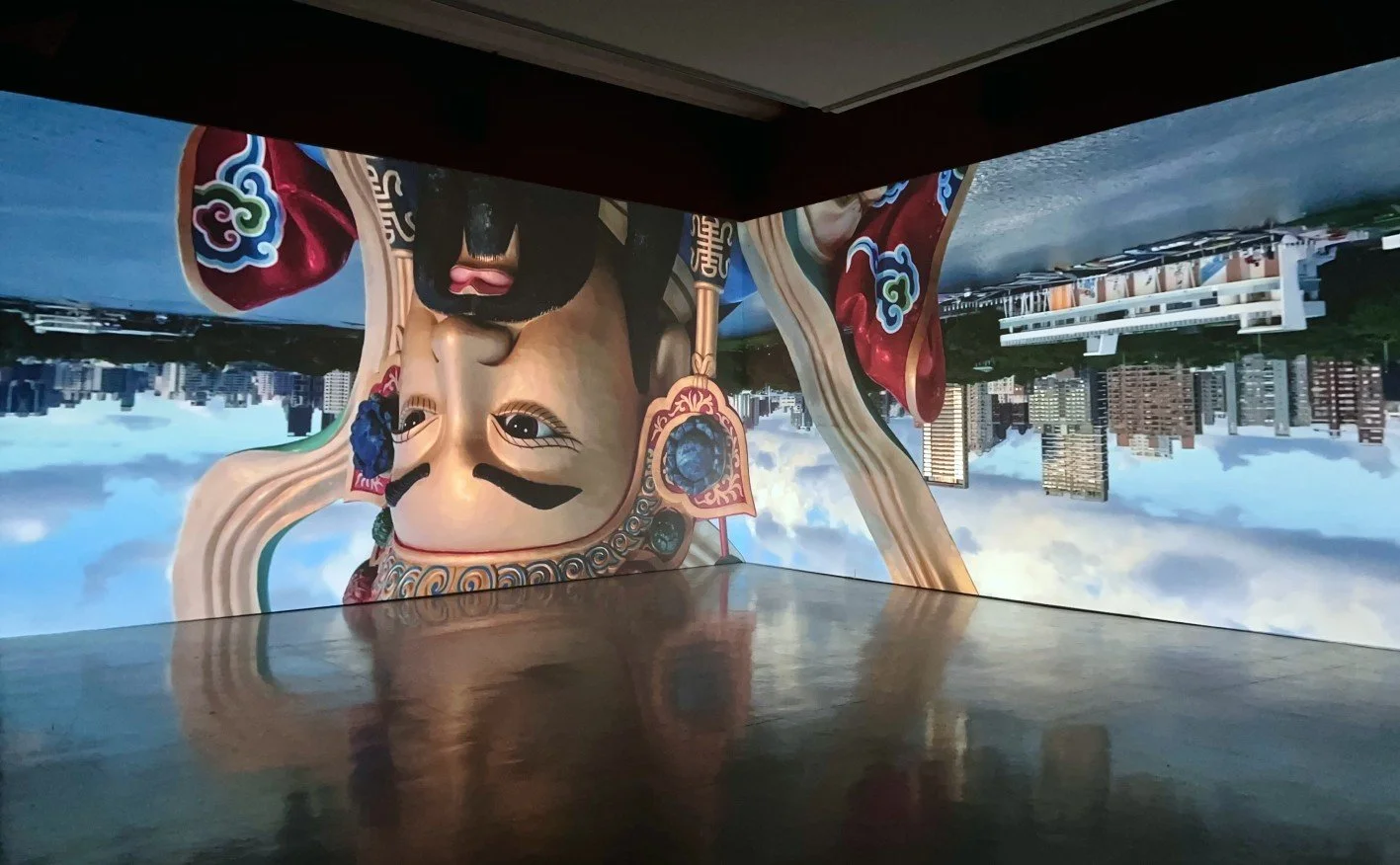
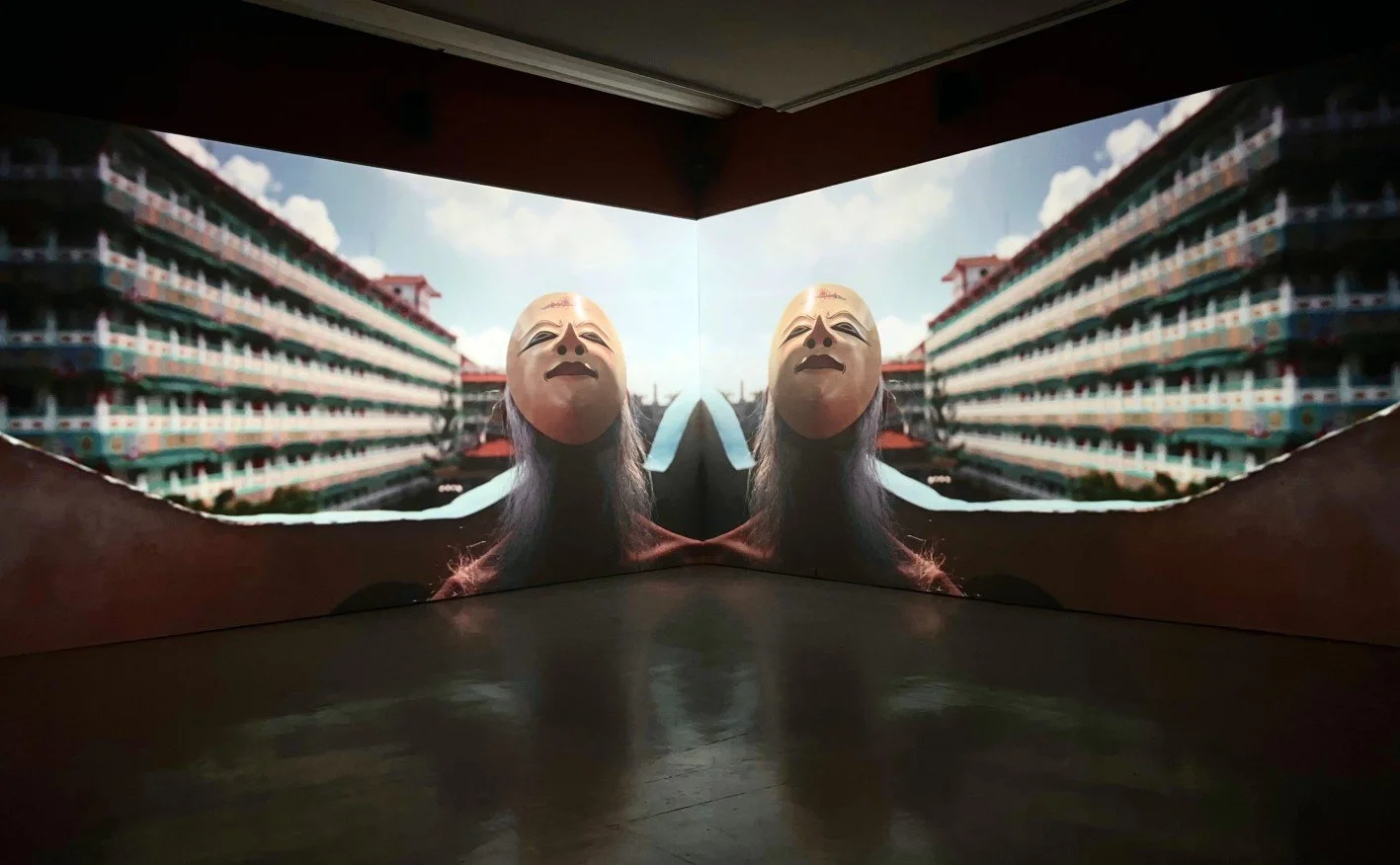
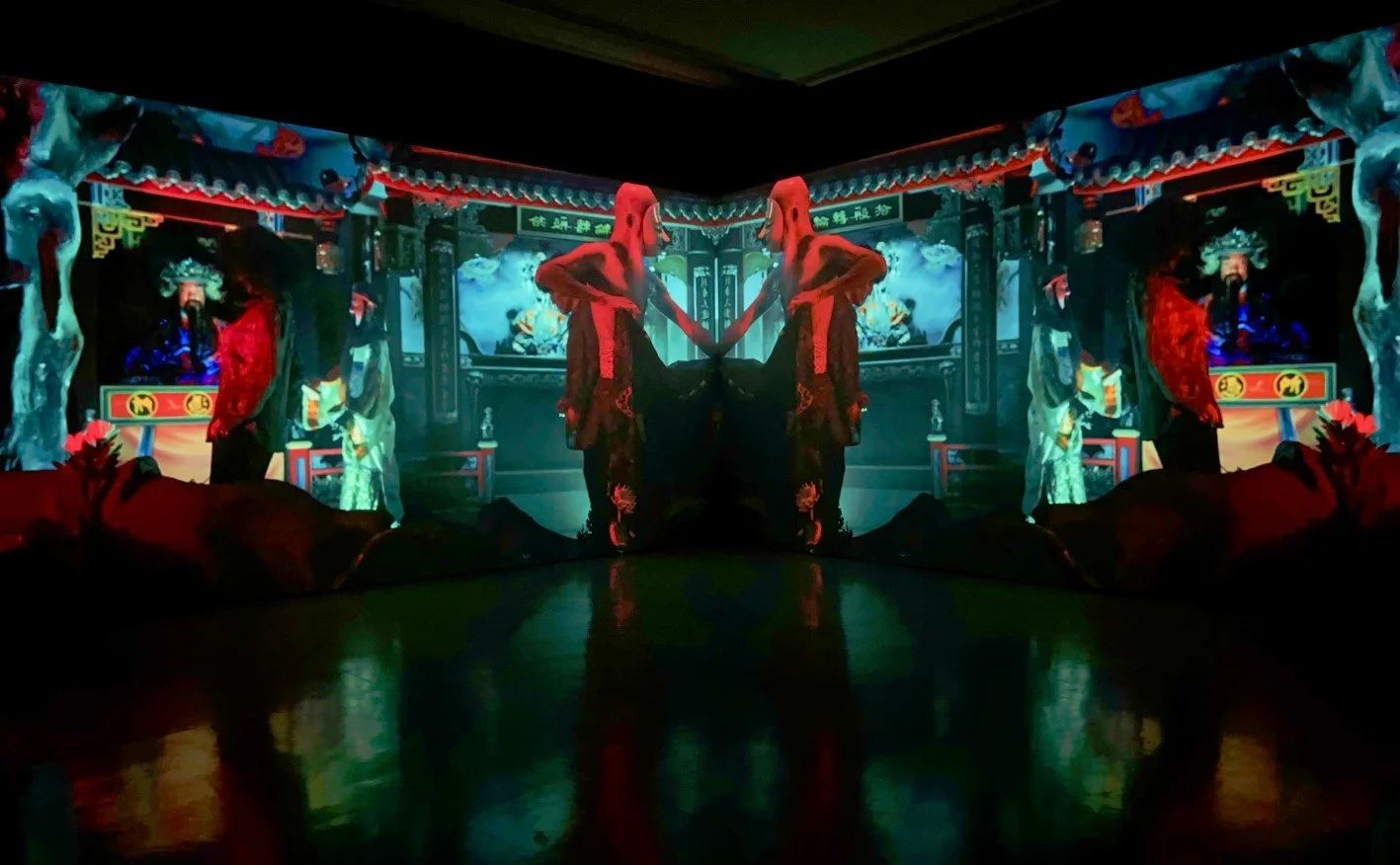
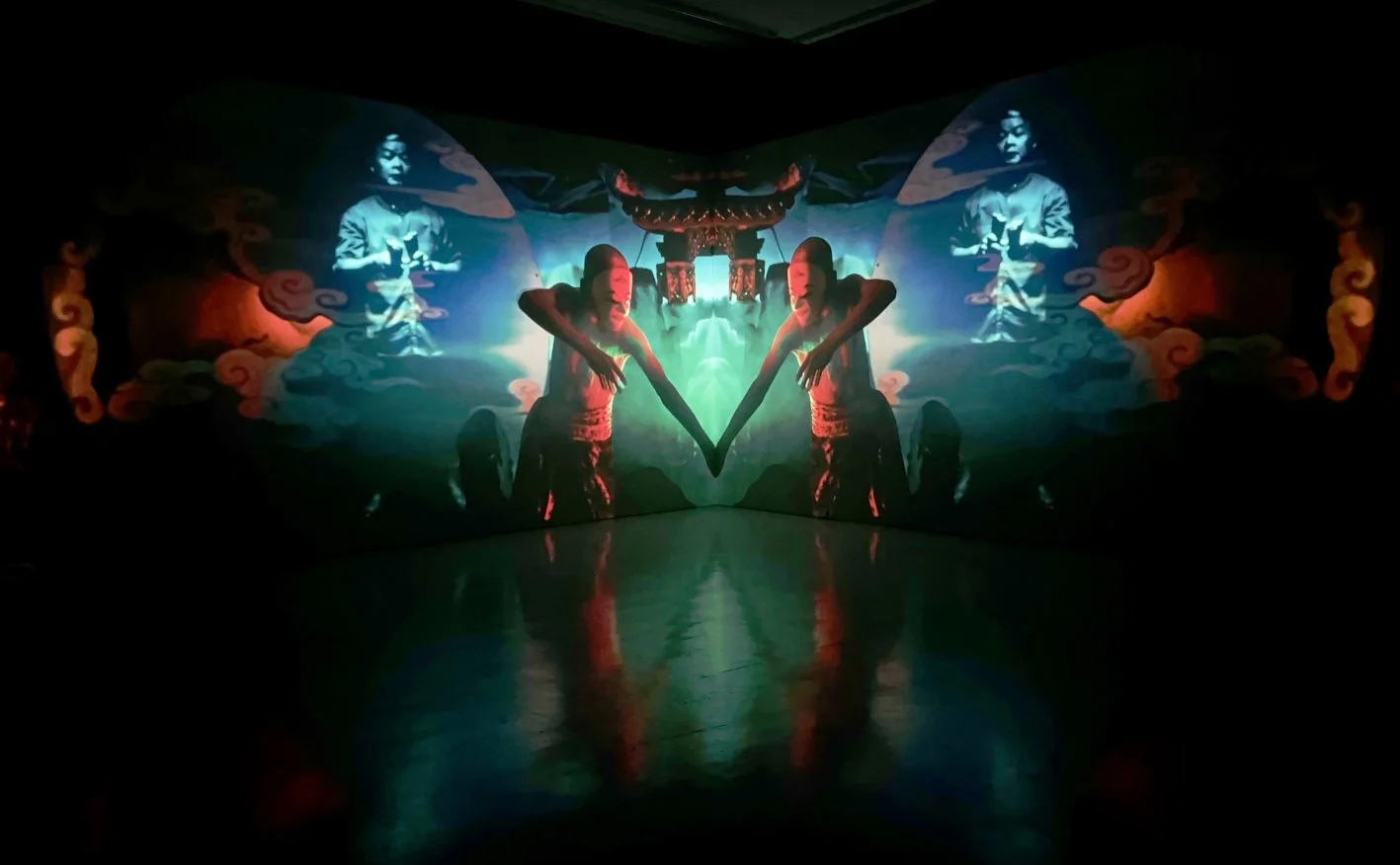
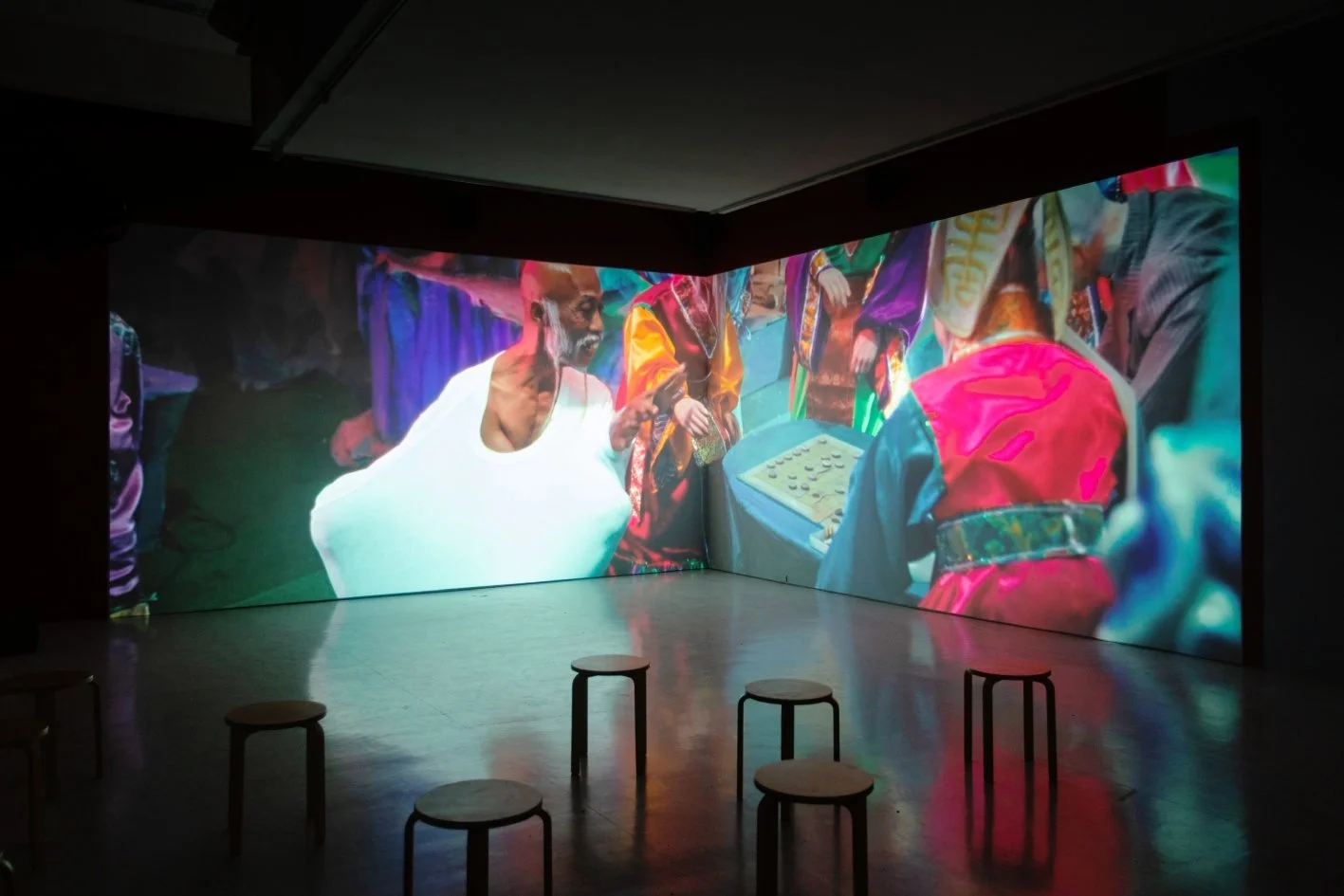
在十字架空間的左邊位置,有一個劇場入口和一個很多方格子空洞的空間,是前一檔展覽的空間保留下來的,這個空間對我來說很有趣,好像一個監控的空間,對面是一個投在牆角90度的雙頻道環繞音效的錄影裝置“未完成之作”。影片分為兩個段落——黑白紀錄片和彩色劇情影像,互相穿插構成一場從現世通往陰界、再回返人間的影像旅程。黑白片段以「靈媒訪談」為主體,我邀請四位靈媒進行深入訪談,彷彿一場延續性的「陰間編劇會議」——透過這些與亡者的對談,我們討論那部尚未完成的作品。在與靈媒訪談時代表我的鏡頭是空拍台灣幾處著名大佛的周邊環境,鏡頭緩慢環繞佛像軀體,再將畫面倒置,使佛在上、天在下,大地懸浮於空,天空沉入地底。這種空間的翻轉,是一種進入異界的儀式感——一種打破常規時空感的視覺轉換,為與靈對話鋪設路徑。對話後的結果為彩色劇情片,呈現我與靈媒、與亡靈反覆對話後所共同構思出的作品內容。這一段在台南麻豆的代天府實地拍攝,形式介於劇情電影與舞蹈錄像之間,融入宗教儀式、身體動作與空間幻象。音樂部分由韓國作曲家李桂華創作,他以南管經典樂曲〈梅花操〉為靈感,為本片量身打造全新配樂,穿梭古老聲響與未竟劇本之間。然而,在拍攝過程中,一件意料之外的事發生了——有一位靈媒竟讓我母親「出現」了,她附身在靈媒身上。這使得原本關於三位台灣劇場前輩的計畫,不再只是關於他們的紀念,而是一場我個人生命歷史的回流與重組。我驚覺,我不再是現在的「我」;或許,我是前世的我,或者是某個第三人稱的我。因此,我邀請曾在過往創作中合作的韓國歌手 Kim Master 擔任「我」的聲音替身。他的聲音不是模仿,而是取代,是另一種存在的軌跡。
On the left side of the cruciform space lies a theatre entrance, adjacent to a hollow structure composed of numerous grid-like compartments—a remnant from the previous exhibition. For me, this space evokes the atmosphere of surveillance, as though one were being observed from within its recesses. Facing it stands a dual-channel video installation with surround sound, projected onto a 90-degree corner wall, entitled Psychic Theatre. The video unfolds in two interwoven movements: black-and-white documentary and color-based fiction. Together, they compose a cinematic passage from the world of the living into the realm of the dead and back again. The black-and-white sequences are excerpts from in-depth conversations with four spirit mediums, which gradually evolved into extended “scripted meetings with the underworld”—dialogues with the deceased about the contours of works left incomplete. During these interviews, my “stand-in” on screen is a series of aerial shots circling around several monumental Buddha statues in Taiwan. The camera slowly orbits their massive bodies, then the image is inverted: the Buddha above, heaven beneath, the earth suspended in air, and the sky sinking downward into the ground. This inversion of space operates as a ritual threshold, a visual gesture of passage into the otherworld, where the rules of time and space are disrupted, clearing a path for dialogue with the dead. The outcome of these dialogues takes shape in the color sequences: a fictional film jointly conceived by myself, the mediums, and the spirits. Shot on-site at the Datian Temple in Madou, Tainan, the work oscillates between narrative cinema and dance film, merging religious ritual, corporeal gestures, and spatial illusions. The soundtrack, composed by the Korean composer Lee Gye-Hwa, draws inspiration from the Nanguan classic The Plum Blossom Story, reimagined as an original score that flows between the sonority of ancient traditions and the spectral traces of an unfinished script. Yet during the filming, an unforeseen event occurred: one of the mediums suddenly “summoned” my mother, who appeared through her body. This unexpected visitation transformed the project. What began as a work of remembrance for three departed Taiwanese theatre directors became, instead, a return and reconfiguration of my own life history. I realized, in that moment, that I was no longer the “I” of the present—perhaps I had become my former self, or perhaps a third-person version of myself. To embody this displacement, I invited the Korean vocalist Kim Master, who has collaborated with me in previous works, to serve as the surrogate voice of “myself.” His voice is not an imitation but a substitution—a parallel existence, a trajectory of being that is at once mine and other.
2025 “未完成之作- 彭弘智個展” 畫冊, 台北市立美術館
2025 “Psychic Theatre- Hung-Chih Peng Solo Exhibition” catalogue, Taipei Fine Arts Musuem, Taiwan
